Ch. 7 - The Reactions of Alkynes • An Introduction to Multistep Synthesis
Bruice - Organic Chemistry 8th Edition
Bruice8th EditionOrganic ChemistryISBN: 9780135213711Not the one you use?Change textbook
Chapter 8, Problem 40h

Answer Problem 39, parts a–h, using 2-butyne as the starting material instead of propyne.
h. H2/Lindlar catalyst

Verified step by step guidance
1
Identify the starting material: The problem specifies 2-butyne as the starting material. This is an alkyne with the structure CH3-C≡C-CH3.
Understand the reagent: H2 with a Lindlar catalyst is used to selectively hydrogenate alkynes to cis-alkenes. The Lindlar catalyst prevents full hydrogenation to an alkane.
Predict the product: When 2-butyne (CH3-C≡C-CH3) reacts with H2/Lindlar catalyst, the triple bond (C≡C) is reduced to a double bond (C=C), and the resulting product is a cis-alkene. The two methyl groups (CH3) on either side of the triple bond will remain in the same relative positions.
Draw the structure of the product: The product will be cis-2-butene, with the structure CH3-CH=CH-CH3, where the two hydrogens added during the reaction are on the same side of the double bond.
Verify stereochemistry: Ensure that the product is the cis-isomer (Z configuration), as the Lindlar catalyst specifically produces the cis-alkene and not the trans-alkene.

Verified video answer for a similar problem:

This video solution was recommended by our tutors as helpful for the problem above.
Video duration:
4m
Was this helpful?

Key Concepts

Here are the essential concepts you must grasp in order to answer the question correctly.

Alkyne Reduction

Alkynes can be reduced to alkenes or alkanes through various catalytic processes. The reduction of 2-butyne specifically involves the addition of hydrogen (H2) across the triple bond, converting it into a double bond (alkene) or a single bond (alkane) depending on the catalyst used.
Recommended video:
Guided course
04:40
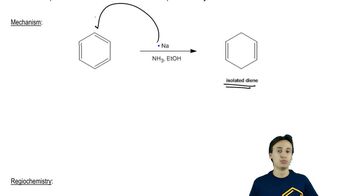
Birch Reduction Mechanism

Lindlar Catalyst

The Lindlar catalyst is a poisoned palladium catalyst that selectively reduces alkynes to cis-alkenes without further reducing them to alkanes. This catalyst is crucial for controlling the degree of hydrogenation, allowing for the formation of specific isomers in organic synthesis.
Recommended video:
2:10
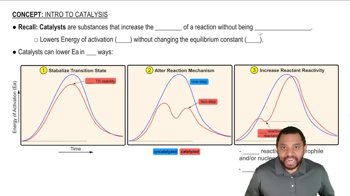
Introduction to Catalysis Concept 1

Stereochemistry of Alkenes

Stereochemistry refers to the spatial arrangement of atoms in molecules and is particularly important in alkenes, which can exist as cis or trans isomers. The use of the Lindlar catalyst in the reduction of 2-butyne will yield cis-2-butene, highlighting the importance of stereochemical considerations in organic reactions.
Recommended video:
1:38
Polymer Stereochemistry Concept 1