Ch. 7 - The Reactions of Alkynes • An Introduction to Multistep Synthesis
Bruice - Organic Chemistry 8th Edition
Bruice8th EditionOrganic ChemistryISBN: 9780135213711Not the one you use?Change textbook
Chapter 8, Problem 18

Only one alkyne forms an aldehyde when it undergoes the mercuric-ion-catalyzed addition of water. Identify the alkyne.

Verified step by step guidance
1
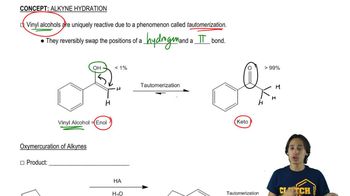
Understand the reaction: The mercuric-ion-catalyzed addition of water to an alkyne is a hydration reaction. In this reaction, the alkyne reacts with water in the presence of Hg²⁺ and an acid (commonly H₂SO₄) to form a ketone or an aldehyde via the enol intermediate, which tautomerizes to the more stable carbonyl compound.
Recall Markovnikov's rule: In the hydration of alkynes, the addition of the hydroxyl group (-OH) follows Markovnikov's rule. This means the -OH group will attach to the more substituted carbon of the triple bond, leading to the formation of a ketone in most cases.
Identify the exception: The only alkyne that forms an aldehyde under these conditions is **ethyne (acetylene, CH≡CH)**. This is because ethyne is a terminal alkyne with no substituents on either carbon of the triple bond. When water adds to ethyne, the enol intermediate tautomerizes to form an aldehyde (ethanal, CH₃CHO).
Write the reaction mechanism: The reaction proceeds as follows: (1) The triple bond of ethyne is activated by the Hg²⁺ catalyst, making it more electrophilic. (2) Water adds to the triple bond, forming an enol intermediate. (3) The enol undergoes keto-enol tautomerization to form the aldehyde.
Conclude: Ethyne is the only alkyne that forms an aldehyde under mercuric-ion-catalyzed hydration because it is the simplest terminal alkyne, and the addition of water leads to the formation of an aldehyde rather than a ketone.

Verified video answer for a similar problem:

This video solution was recommended by our tutors as helpful for the problem above.
Video duration:
6m
Was this helpful?

Key Concepts

Here are the essential concepts you must grasp in order to answer the question correctly.

Alkynes

Alkynes are hydrocarbons that contain at least one carbon-carbon triple bond. They are unsaturated compounds and are generally more reactive than alkenes and alkanes due to the presence of the triple bond. The simplest alkyne is ethyne (acetylene), and they can undergo various reactions, including addition reactions, which are crucial for understanding their reactivity.
Recommended video:
Guided course
09:11
Alkyne Hydration

Mercuric-Ion-Catalyzed Hydration

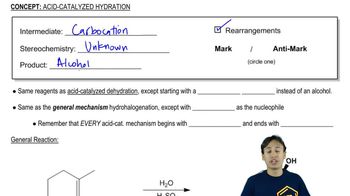
The mercuric-ion-catalyzed hydration of alkynes involves the addition of water across the triple bond in the presence of mercuric ions (Hg2+). This reaction typically leads to the formation of a ketone or an aldehyde, depending on the structure of the alkyne. The mechanism involves the formation of a mercuric alkynyl intermediate, which is then hydrolyzed to yield the carbonyl compound.
Recommended video:
Guided course
06:32
General properties of acid-catalyzed hydration.

Aldehyde Formation

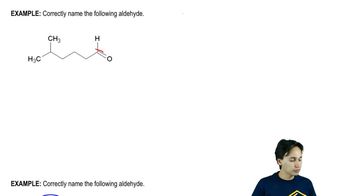
Aldehydes are organic compounds characterized by the presence of a carbonyl group (C=O) at the end of a carbon chain. In the context of alkyne hydration, an aldehyde is formed when a terminal alkyne undergoes hydration, resulting in the addition of a water molecule to the carbon-carbon triple bond. This process is significant because it highlights the unique reactivity of terminal alkynes compared to internal alkynes.
Recommended video:
Guided course
01:34
Name the aldehyde