Ch. 7 - The Reactions of Alkynes • An Introduction to Multistep Synthesis
Bruice - Organic Chemistry 8th Edition
Bruice8th EditionOrganic ChemistryISBN: 9780135213711Not the one you use?Change textbook
Chapter 8, Problem 15a,b

Which alkyne should be used for the synthesis of each of the following ketones?
a.
b.

Verified step by step guidance
1
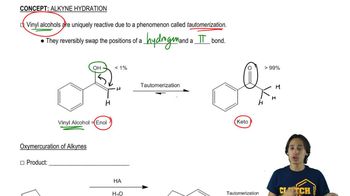
Step 1: Recognize that ketones can be synthesized from alkynes via hydration reactions. In the presence of water, an alkyne undergoes addition to form an enol intermediate, which tautomerizes into a ketone.
Step 2: Identify the structure of the ketone provided in part (a). The ketone has a methyl group on one side and another methyl group on the other side of the carbonyl group. This suggests that the alkyne used should have two methyl groups attached to the triple bond.
Step 3: For part (a), propose the alkyne structure that would lead to the given ketone. The alkyne should be symmetrical, such as 2-butyne (CH₃C≡CCH₃), because hydration of this alkyne will yield the desired ketone.
Step 4: Identify the structure of the ketone provided in part (b). The ketone has ethyl groups on both sides of the carbonyl group. This suggests that the alkyne used should have two ethyl groups attached to the triple bond.
Step 5: For part (b), propose the alkyne structure that would lead to the given ketone. The alkyne should be symmetrical, such as 3-hexyne (CH₃CH₂C≡CCH₂CH₃), because hydration of this alkyne will yield the desired ketone.

Verified video answer for a similar problem:

This video solution was recommended by our tutors as helpful for the problem above.
Video duration:
7m
Was this helpful?

Key Concepts

Here are the essential concepts you must grasp in order to answer the question correctly.

Alkynes

Alkynes are hydrocarbons that contain at least one carbon-carbon triple bond. They are unsaturated compounds and can participate in various chemical reactions, including addition reactions. Understanding the structure and reactivity of alkynes is crucial for predicting the products of reactions and for their use in organic synthesis.
Recommended video:
Guided course
09:11
Alkyne Hydration

Ketone Synthesis

Ketones are organic compounds characterized by a carbonyl group (C=O) flanked by two carbon atoms. The synthesis of ketones often involves the reaction of alkynes with specific reagents, such as water in the presence of acid or base, to yield the desired ketone. Familiarity with the mechanisms of these reactions is essential for determining which alkyne to use for synthesizing a particular ketone.
Recommended video:
Guided course
02:27
Name the ketone

Markovnikov's Rule

Markovnikov's Rule states that in the addition of HX to an alkene or alkyne, the hydrogen atom will attach to the carbon with the greater number of hydrogen atoms already attached. This principle helps predict the regioselectivity of reactions involving alkynes, which is important when determining the correct alkyne to use for synthesizing specific ketones based on the structure of the desired product.
Recommended video:
Guided course
03:54
The 18 and 16 Electron Rule