Ch. 8 - Delocalized Electrons: Their Effect on Stability, pKa, and the Products of a Reaction • Aromaticity and Electronic Effects: An Introduction to the Reactions of Benzene
Bruice - Organic Chemistry 8th Edition
Bruice8th EditionOrganic ChemistryISBN: 9780135213711Not the one you use?Change textbook
Chapter 9, Problem 86e

Answer the following questions for the molecular orbitals (MOs) of 1,3,5,7-octatetraene:
e. Which MO is the HOMO and which is the LUMO in the excited state?

Verified step by step guidance
1
Step 1: Understand the structure of 1,3,5,7-octatetraene. It is a conjugated system with 8 π-electrons distributed across 4 double bonds. The molecular orbitals (MOs) are formed by the combination of the p-orbitals from the conjugated system, resulting in bonding, non-bonding, and anti-bonding MOs.
Step 2: Recall the Aufbau principle for filling molecular orbitals. In the ground state, the π-electrons fill the MOs starting from the lowest energy level (most bonding) to the highest energy level (least bonding or anti-bonding). The highest occupied molecular orbital (HOMO) and the lowest unoccupied molecular orbital (LUMO) are identified based on this filling.
Step 3: In the excited state, one of the electrons from the HOMO is promoted to the LUMO. This changes the electron configuration of the molecule, and the new HOMO and LUMO must be identified based on the updated electron distribution.
Step 4: Determine the new HOMO in the excited state. After the electron is promoted, the previously occupied HOMO becomes partially or fully unoccupied, and the next lower energy orbital that is still fully occupied becomes the new HOMO.
Step 5: Determine the new LUMO in the excited state. After the electron is promoted, the previously unoccupied LUMO becomes partially or fully occupied, and the next higher energy orbital that is still unoccupied becomes the new LUMO.

Verified video answer for a similar problem:

This video solution was recommended by our tutors as helpful for the problem above.
Video duration:
5m
Was this helpful?

Key Concepts

Here are the essential concepts you must grasp in order to answer the question correctly.

Molecular Orbitals (MOs)

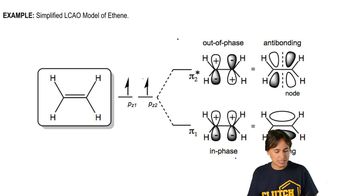
Molecular orbitals are formed by the combination of atomic orbitals when atoms bond together. They can be classified as bonding, antibonding, or non-bonding orbitals, and they play a crucial role in determining the electronic structure of molecules. In conjugated systems like octatetraene, MOs are filled according to the Aufbau principle, influencing the molecule's reactivity and properties.
Recommended video:
Guided course
08:41
Review of Molecular Orbitals

HOMO and LUMO

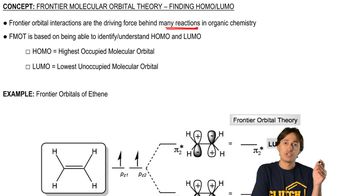
The Highest Occupied Molecular Orbital (HOMO) is the molecular orbital that contains the highest energy electrons in a ground state molecule, while the Lowest Unoccupied Molecular Orbital (LUMO) is the lowest energy orbital that is unoccupied. The energy gap between the HOMO and LUMO is critical for understanding electronic transitions, such as those occurring during excitation, which can lead to absorption of light and other photophysical processes.
Recommended video:
Guided course
02:35
HOMO vs. LUMO

Excited State

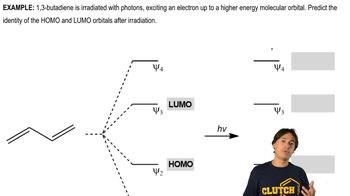
An excited state refers to a condition of a molecule where one or more electrons have absorbed energy and moved to a higher energy level, typically from the HOMO to the LUMO. This transition alters the molecule's electronic configuration and can significantly affect its chemical reactivity and spectral properties. Understanding the excited state is essential for predicting how a molecule will interact with light and other forms of energy.
Recommended video:
Guided course
03:08
Ground vs. Excited States