Textbook Question
Answer the following questions for the molecular orbitals (MOs) of 1,3,5,7-octatetraene:
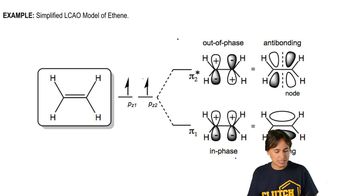
d. Which MO is the HOMO and which is the LUMO in the ground state?
1160
views

 Bruice 8th EditionCh. 8 - Delocalized Electrons: Their Effect on Stability, pKa, and the Products of a Reaction • Aromaticity and Electronic Effects: An Introduction to the Reactions of BenzeneProblem 86g
 Verified step by step guidance
 08:41
08:41 08:41
08:41 03:04
03:04Answer the following questions for the molecular orbitals (MOs) of 1,3,5,7-octatetraene:
d. Which MO is the HOMO and which is the LUMO in the ground state?
Answer the following questions for the molecular orbitals (MOs) of 1,3,5,7-octatetraene:
e. Which MO is the HOMO and which is the LUMO in the excited state?
A student obtained two products from the reaction of 1,3-cyclohexadiene with Br2 (disregarding stereoisomers). His lab partner was surprised when he obtained only one product from the reaction of 1,3-cyclohexadiene with HBr (disregarding stereoisomers). Account for these results.
How could you synthesize the following compound from starting materials containing no more than six carbons?
How could the following compounds be synthesized using a Diels–Alder reaction?
a.
Answer the following questions for the molecular orbitals (MOs) of 1,3,5,7-octatetraene:
f. What is the relationship between HOMO and LUMO and symmetric and antisymmetric orbitals?