Textbook Question
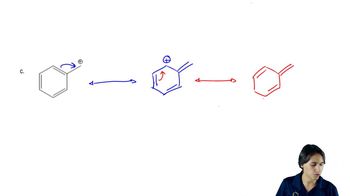
Draw the resonance contributors for the phenolate ion.
1587
views

 Bruice 8th EditionCh. 8 - Delocalized Electrons: Their Effect on Stability, pKa, and the Products of a Reaction • Aromaticity and Electronic Effects: An Introduction to the Reactions of BenzeneProblem 94b
 Verified step by step guidance
 03:04
03:04
 3:39
3:39 08:19
08:19Draw the resonance contributors for the phenolate ion.
Protonated cyclohexylamine has a Ka = 1 * 10-11. Using the same sequence of steps as in Problem 94, determine which is a stronger base: cyclohexylamine
or aniline.
e. Which has a greater Ka: cyclohexylammmonium ion or anilinium ion?
f. Which is a stronger acid: cyclohexylamine or aniline?
How would the following substituents affect the rate of a Diels–Alder reaction?
b. an electron-donating substituent in the dienophile
e. Which has a greater Ka: cyclohexanol or phenol?
f. Which is a stronger acid: cyclohexanol or phenol?
How would the following substituents affect the rate of a Diels–Alder reaction?
c. an electron-withdrawing substituent in the diene
The acid dissociation constant (Ka) for loss of a proton from cyclohexanol is 1 × 10–16.
a. Draw a reaction coordinate diagram for loss of a proton from cyclohexanol.