Draw the resonance contributors for the phenolate ion.
Ch. 8 - Delocalized Electrons: Their Effect on Stability, pKa, and the Products of a Reaction • Aromaticity and Electronic Effects: An Introduction to the Reactions of Benzene
All textbooks
Bruice 8th Edition
Ch. 8 - Delocalized Electrons: Their Effect on Stability, pKa, and the Products of a Reaction • Aromaticity and Electronic Effects: An Introduction to the Reactions of Benzene
Problem 92c
Bruice 8th Edition
Ch. 8 - Delocalized Electrons: Their Effect on Stability, pKa, and the Products of a Reaction • Aromaticity and Electronic Effects: An Introduction to the Reactions of Benzene
Problem 92cChapter 9, Problem 92c
How would the following substituents affect the rate of a Diels–Alder reaction?
c. an electron-withdrawing substituent in the diene
Verified step by step guidance1
Understand the Diels–Alder reaction: It is a [4+2] cycloaddition reaction between a conjugated diene and a dienophile. The reaction is facilitated by electronic interactions between the diene and the dienophile.
Recall the role of substituents: Electron-donating groups (EDGs) on the diene increase its reactivity by raising the energy of its highest occupied molecular orbital (HOMO), making it more reactive. Conversely, electron-withdrawing groups (EWGs) on the diene lower the energy of its HOMO, reducing its reactivity.
Analyze the effect of an electron-withdrawing substituent: An EWG on the diene (e.g., -NO₂, -CN, -COOH) will pull electron density away from the conjugated π-system of the diene. This decreases the nucleophilicity of the diene and lowers the energy of its HOMO.
Relate this to the reaction rate: Since the Diels–Alder reaction depends on the interaction between the HOMO of the diene and the lowest unoccupied molecular orbital (LUMO) of the dienophile, a lower HOMO energy in the diene will result in a less favorable interaction, thereby slowing down the reaction rate.
Conclude: An electron-withdrawing substituent in the diene will decrease the rate of the Diels–Alder reaction by reducing the diene's reactivity.

Verified video answer for a similar problem:
This video solution was recommended by our tutors as helpful for the problem above.
Video duration:
7mWas this helpful?
Key Concepts
Here are the essential concepts you must grasp in order to answer the question correctly.
Diels–Alder Reaction
The Diels–Alder reaction is a [4+2] cycloaddition between a conjugated diene and a dienophile, forming a six-membered ring. This reaction is a key method in organic synthesis for constructing cyclic compounds. The reactivity of the diene and dienophile is influenced by their electronic properties, which can be modified by substituents.
Recommended video:
Guided course
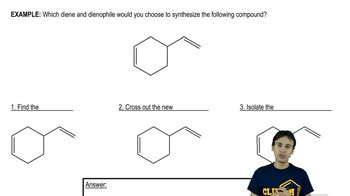
Diels-Alder Retrosynthesis
Electron-Withdrawing Substituents
Electron-withdrawing substituents (EWS) are groups that pull electron density away from the rest of the molecule, often through resonance or inductive effects. In the context of a diene, the presence of an EWS can stabilize the diene's conjugated system, making it less nucleophilic and thus less reactive in a Diels–Alder reaction. This can lead to a slower reaction rate.
Recommended video:
Guided course
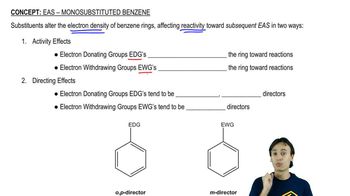
Activity and Directing Effects
Reactivity of Dienes
The reactivity of dienes in Diels–Alder reactions is significantly influenced by their electronic characteristics. Dienes that are electron-rich are more reactive towards electron-deficient dienophiles, while electron-poor dienes are less reactive. Therefore, the introduction of an electron-withdrawing substituent in the diene decreases its reactivity, affecting the overall rate of the reaction.
Recommended video:
Guided course
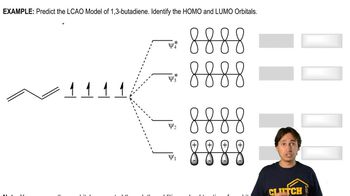
Drawing MO Diagram for Dienes
Related Practice
Textbook Question
1587
views
Textbook Question
How would the following substituents affect the rate of a Diels–Alder reaction?
b. an electron-donating substituent in the dienophile
1223
views
Textbook Question
Draw the resonance contributors for phenol.
1329
views
Textbook Question
Draw the products obtained from the reaction of one equivalent of HBr with one equivalent of 1,3,5-hexatriene.
a. Which product(s) will predominate if the reaction is under kinetic control?
b. Which product(s) will predominate if the reaction is under thermodynamic control?
1605
views
Textbook Question
The acid dissociation constant (Ka) for loss of a proton from cyclohexanol is 1 × 10–16.
a. Draw a reaction coordinate diagram for loss of a proton from cyclohexanol.
1121
views
Textbook Question
How would the following substituents affect the rate of a Diels–Alder reaction?
a. an electron-donating substituent in the diene
1240
views