
Refer to the electrostatic potential maps <IMAGE> to answer the following questions:
c. Why is the center of the electrostatic potential map of benzene more red than the center of the electrostatic potential map of pyridine?
Bruice 8th Edition
Ch. 8 - Delocalized Electrons: Their Effect on Stability, pKa, and the Products of a Reaction • Aromaticity and Electronic Effects: An Introduction to the Reactions of Benzene
Problem 57a
Verified step by step guidance
Refer to the electrostatic potential maps <IMAGE> to answer the following questions:
c. Why is the center of the electrostatic potential map of benzene more red than the center of the electrostatic potential map of pyridine?
What orbital do the lone-pair electrons occupy in each of the following compounds?
a.
b.
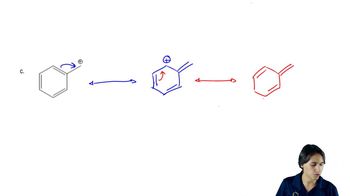
c.
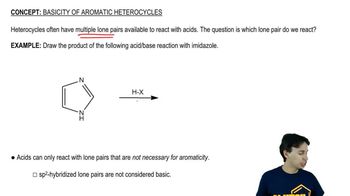
Which of the following compounds could be protonated without destroying its aromaticity?
Following the instructions for drawing the energy levels of the molecular orbitals for the compounds shown in [Figure 8.17], draw the energy levels of the molecular orbitals for the cycloheptatrienyl cation. For each compound, show the distribution of the electrons. Which of the compounds are aromatic?
What orbitals contain the electrons represented as lone pairs in the structures of purine, and pyrimidine?
Following the instructions for drawing the energy levels of the molecular orbitals for the compounds shown in [Figure 8.17], draw the energy levels of the molecular orbitals for the cycloheptatrienyl cation. For each compound, show the distribution of the electrons. Which of the compounds are aromatic?