
Ch. 8 - Delocalized Electrons: Their Effect on Stability, pKa, and the Products of a Reaction • Aromaticity and Electronic Effects: An Introduction to the Reactions of Benzene
Bruice - Organic Chemistry 8th Edition
Bruice8th EditionOrganic ChemistryISBN: 9780135213711Not the one you use?Change textbook
Chapter 9, Problem 12

Name the following dienes and rank them from most stable to least stable.
Chemical structures of various dienes with labels, asking to rank their stability from most to least stable.

Verified step by step guidance
1
Identify the structure of each diene in the image. Look for the presence of conjugated double bonds, isolated double bonds, or cumulated double bonds.
Apply the IUPAC naming rules to each diene. Start by identifying the longest carbon chain that includes both double bonds, and number the chain starting from the end closest to the first double bond.
Determine the position of each double bond in the chain and use the appropriate locants in the name. Remember to use the suffix '-diene' to indicate the presence of two double bonds.
Evaluate the stability of each diene. Conjugated dienes (where double bonds are separated by a single bond) are generally more stable than isolated dienes (where double bonds are separated by more than one single bond) and cumulated dienes (where double bonds are adjacent).
Rank the dienes from most stable to least stable based on their structure. Conjugated dienes are typically the most stable due to resonance stabilization, followed by isolated dienes, and cumulated dienes are usually the least stable.

Verified video answer for a similar problem:

This video solution was recommended by our tutors as helpful for the problem above.
Video duration:
4m
Was this helpful?

Key Concepts

Here are the essential concepts you must grasp in order to answer the question correctly.

Diene Stability

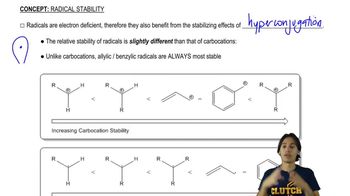
Diene stability refers to the relative stability of compounds containing two double bonds. Factors influencing this stability include the degree of substitution on the double bonds, with more substituted dienes generally being more stable due to hyperconjugation and the inductive effect. Additionally, the presence of conjugation, where double bonds are separated by a single bond, can enhance stability through resonance.
Recommended video:
Guided course
03:43
The radical stability trend.

Conjugation

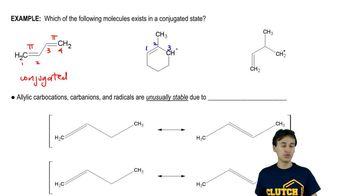
Conjugation occurs when alternating single and double bonds allow for the delocalization of π electrons across the molecule. This delocalization stabilizes the molecule, making conjugated dienes more stable than isolated double bonds. The stability from conjugation is a key factor when ranking the stability of different diene structures.
Recommended video:
Guided course
03:27
Conjugated states

Substitution Patterns

The substitution pattern of a diene significantly affects its stability. Dienes can be classified as 1,2-disubstituted, 1,3-disubstituted, or unsubstituted, with 1,3-disubstituted dienes typically being the most stable due to increased hyperconjugation and steric effects. Understanding these patterns is essential for accurately ranking the stability of the given dienes.
Recommended video:
Guided course
08:06
Common Splitting Patterns