
Ch. 8 - Delocalized Electrons: Their Effect on Stability, pKa, and the Products of a Reaction • Aromaticity and Electronic Effects: An Introduction to the Reactions of Benzene
Bruice - Organic Chemistry 8th Edition
Bruice8th EditionOrganic ChemistryISBN: 9780135213711Not the one you use?Change textbook
Chapter 9, Problem 15d,e

Answer the following questions for the MOs of 1,3-butadiene:
d. Which MO is the HOMO and which is the LUMO in the excited state?
e. What is the relationship between the HOMO and the LUMO and symmetric and antisymmetric orbitals?

Verified step by step guidance
1
Step 1: Understand the molecular orbital (MO) theory for 1,3-butadiene. 1,3-butadiene has four π-electrons, which occupy molecular orbitals formed by the combination of the four p-orbitals on the carbon atoms. These MOs are labeled as π1, π2, π3*, and π4*, where π1 and π2 are bonding orbitals, and π3* and π4* are antibonding orbitals.
Step 2: Identify the HOMO (Highest Occupied Molecular Orbital) and LUMO (Lowest Unoccupied Molecular Orbital) in the ground state. In the ground state, the four π-electrons fill the two lowest energy bonding orbitals, π1 and π2. Thus, π2 is the HOMO, and π3* is the LUMO in the ground state.
Step 3: Determine the HOMO and LUMO in the excited state. In the excited state, one electron from the HOMO (π2) is promoted to the LUMO (π3*). As a result, the new HOMO becomes π3*, and the new LUMO becomes π4*.
Step 4: Explain the relationship between symmetry and the MOs. Molecular orbitals can be classified as symmetric or antisymmetric based on their behavior under reflection through the molecular plane or inversion through the center of symmetry. For 1,3-butadiene, π1 and π3* are symmetric orbitals, while π2 and π4* are antisymmetric orbitals.
Step 5: Relate the HOMO and LUMO to symmetry. In the excited state, the HOMO (π3*) is symmetric, and the LUMO (π4*) is antisymmetric. This symmetry relationship is important for understanding electronic transitions and reactivity in conjugated systems.

Verified video answer for a similar problem:

This video solution was recommended by our tutors as helpful for the problem above.
Video duration:
3m
Was this helpful?

Key Concepts

Here are the essential concepts you must grasp in order to answer the question correctly.

Molecular Orbitals (MOs)

Molecular orbitals are formed by the linear combination of atomic orbitals when atoms bond together. In the case of 1,3-butadiene, the MOs can be classified based on their energy levels, with the highest occupied molecular orbital (HOMO) being the highest energy orbital that contains electrons, and the lowest unoccupied molecular orbital (LUMO) being the lowest energy orbital that is empty. Understanding these orbitals is crucial for analyzing electronic transitions and reactivity.
Recommended video:
Guided course
08:41
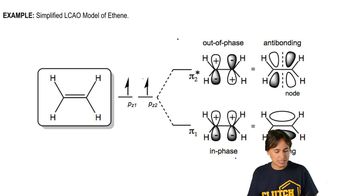
Review of Molecular Orbitals

HOMO and LUMO

The HOMO (highest occupied molecular orbital) and LUMO (lowest unoccupied molecular orbital) are key concepts in molecular orbital theory that describe the electronic structure of a molecule. The HOMO is the orbital that contains the highest energy electrons, while the LUMO is the first available orbital for electron excitation. The energy gap between these two orbitals is significant for predicting the molecule's reactivity and absorption of light, particularly in excited states.
Recommended video:
Guided course
02:35
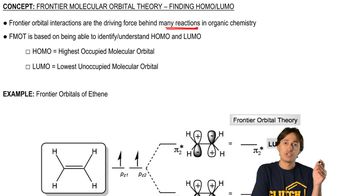
HOMO vs. LUMO

Symmetric and Antisymmetric Orbitals

Symmetric and antisymmetric orbitals refer to the behavior of molecular orbitals under the exchange of two identical particles, such as electrons. Symmetric orbitals remain unchanged when the particles are swapped, while antisymmetric orbitals change sign. This distinction is important in determining the allowed configurations of electrons in MOs, influencing the stability and reactivity of the molecule, particularly in the context of excited states and electronic transitions.
Recommended video:
Guided course
03:44
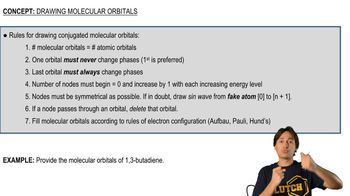
The 7 Rules of Drawing Molecular Orbitals