
Answer the following questions for the MOs of 1,3-butadiene:
a. Which are bonding MOs, and which are * antibonding MOs?
b. Which MOs are symmetric, and which are antisymmetric?
c. Which MO is the HOMO and which is the LUMO in the ground state?
Bruice 8th Edition
Ch. 8 - Delocalized Electrons: Their Effect on Stability, pKa, and the Products of a Reaction • Aromaticity and Electronic Effects: An Introduction to the Reactions of Benzene
Problem 18c,d
Verified step by step guidance
Answer the following questions for the MOs of 1,3-butadiene:
a. Which are bonding MOs, and which are * antibonding MOs?
b. Which MOs are symmetric, and which are antisymmetric?
c. Which MO is the HOMO and which is the LUMO in the ground state?
Answer the following questions for the MOs of 1,3-butadiene:
d. Which MO is the HOMO and which is the LUMO in the excited state?
e. What is the relationship between the HOMO and the LUMO and symmetric and antisymmetric orbitals?
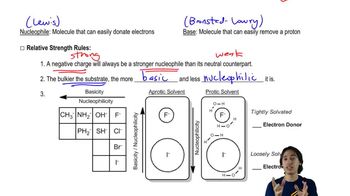
Which member of each pair is the stronger base?
a. ethylamine or aniline
b. ethylamine or ethoxide ion
For each of the following substituents, indicate whether it withdraws electrons inductively, donates electrons by hyperconjugation, withdraws electrons by resonance, or donates electrons by resonance.
d. NHCH3
e. OCH3
f. +N(CH3)3
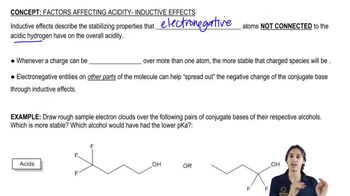
Which acid in each of the following pairs is stronger?
c.
d.
For each of the following substituents, indicate whether it withdraws electrons inductively, donates electrons by hyperconjugation, withdraws electrons by resonance, or donates electrons by resonance.
a. Br
b. CH2CH3
c.