Ch. 9 - Substitution and Elimination Reactions of Alkyl Halides
Bruice - Organic Chemistry 8th Edition
Bruice8th EditionOrganic ChemistryISBN: 9780135213711Not the one you use?Change textbook
Chapter 10, Problem 74c,d

Rank the following species in each set from best nucleophile to poorest nucleophile.
c. H2O and NH3 in methanol
d. Br, Cl, I in methanol

Verified step by step guidance
1
Step 1: Understand the concept of nucleophilicity. Nucleophilicity refers to the ability of a species to donate a pair of electrons to an electrophile. It is influenced by factors such as charge, electronegativity, solvent effects, and steric hindrance.
Step 2: Analyze the solvent. Methanol is a polar protic solvent, meaning it can form hydrogen bonds with nucleophiles. Polar protic solvents tend to stabilize smaller, more electronegative nucleophiles through hydrogen bonding, reducing their nucleophilicity. Larger, less electronegative nucleophiles are less stabilized and thus more nucleophilic in such solvents.
Step 3: Compare H₂O and NH₃ in methanol. NH₃ (ammonia) is less electronegative than H₂O (water), meaning it holds its lone pair of electrons less tightly and is more willing to donate them. Additionally, NH₃ is less hydrogen-bonded in methanol compared to H₂O, making NH₃ the better nucleophile in this solvent.
Step 4: Compare Br⁻, Cl⁻, and I⁻ in methanol. In polar protic solvents like methanol, larger anions are better nucleophiles because they are less solvated (less stabilized by hydrogen bonding). I⁻ is the largest ion, followed by Br⁻, and then Cl⁻. Therefore, the nucleophilicity order in methanol is I⁻ > Br⁻ > Cl⁻.
Step 5: Summarize the rankings. For part (c), NH₃ is a better nucleophile than H₂O in methanol. For part (d), the nucleophilicity order in methanol is I⁻ > Br⁻ > Cl⁻. These rankings are based on the effects of the polar protic solvent and the intrinsic properties of the nucleophiles.

Verified video answer for a similar problem:

This video solution was recommended by our tutors as helpful for the problem above.
Video duration:
3m
Was this helpful?

Key Concepts

Here are the essential concepts you must grasp in order to answer the question correctly.

Nucleophilicity

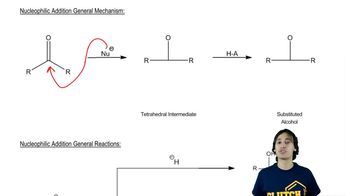
Nucleophilicity refers to the ability of a species to donate an electron pair to an electrophile, forming a chemical bond. It is influenced by factors such as charge, electronegativity, and solvent effects. Generally, negatively charged species are stronger nucleophiles than their neutral counterparts, and nucleophilicity can vary significantly in different solvents.
Recommended video:
Guided course
08:27
Nucleophilic Addition

Solvent Effects

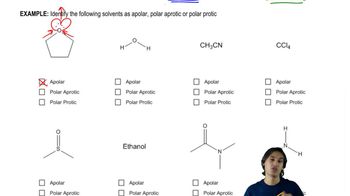
The solvent can significantly impact nucleophilicity by stabilizing or destabilizing the nucleophile. In polar protic solvents like methanol, nucleophiles are often less nucleophilic due to solvation effects, where solvent molecules surround and stabilize the nucleophile, making it less available to react. Understanding how solvents interact with nucleophiles is crucial for predicting their reactivity.
Recommended video:
Guided course
01:16
Identification of polarity in solvents

Comparative Nucleophilicity of Halides

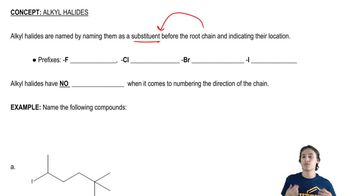
When comparing halide ions (Br−, Cl−, I−), their nucleophilicity generally increases down the group in the periodic table due to decreasing electronegativity and increasing size. Iodide (I−) is typically the strongest nucleophile among the three, while bromide (Br−) is stronger than chloride (Cl−). This trend is important for ranking nucleophiles in reactions.
Recommended video:
Guided course
01:52
How to name alkyl halides