


Ch. 9 - Substitution and Elimination Reactions of Alkyl Halides
Bruice - Organic Chemistry 8th Edition
Bruice8th EditionOrganic ChemistryISBN: 9780135213711Not the one you use?Change textbook
Chapter 10, Problem 33(1)

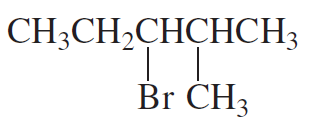
a. What is the major product obtained when each of the following compounds undergoes an E2 reaction with methoxide ion? Show the configuration of the product.
b. Does the product obtained depend on whether you start with the R or S enantiomer of the reactant?
1. Structural formula of a compound with a bromine substituent, illustrating an E2 reaction scenario.

Verified step by step guidance
1
Step 1: Identify the type of reaction. The problem specifies an E2 elimination reaction, which is a bimolecular elimination mechanism. In this reaction, a strong base (methoxide ion) removes a proton from a β-carbon, and the leaving group (chlorine) departs simultaneously, forming a double bond.
Step 2: Analyze the structure of the reactant. The given compound is a secondary alkyl chloride. The β-hydrogens are located on the carbons adjacent to the carbon bonded to the chlorine atom. Identify all possible β-hydrogens and their positions.
Step 3: Determine the most stable alkene product. In E2 reactions, the major product is typically the more substituted alkene due to Zaitsev's rule. Evaluate the possible double bonds that can form and select the one with the highest degree of substitution.
Step 4: Consider the stereochemistry of the reaction. E2 reactions require the β-hydrogen and the leaving group to be anti-periplanar (in opposite planes). Check the configuration of the reactant to ensure that the elimination can occur in this geometry.
Step 5: Address part b of the question. The product obtained in an E2 reaction does not depend on whether the reactant is the R or S enantiomer because the stereochemistry of the starting material does not affect the regiochemistry of the elimination. However, the stereochemistry of the product may differ depending on the anti-periplanar arrangement of the β-hydrogen and the leaving group.

Verified video answer for a similar problem:

This video solution was recommended by our tutors as helpful for the problem above.
Video duration:
7m
Was this helpful?

Key Concepts

Here are the essential concepts you must grasp in order to answer the question correctly.

E2 Reaction Mechanism

The E2 (bimolecular elimination) reaction is a type of elimination reaction where a base removes a proton from a β-carbon, leading to the simultaneous departure of a leaving group (like Cl) from the α-carbon. This concerted mechanism results in the formation of a double bond. The stereochemistry of the reaction is crucial, as it typically favors the formation of the more stable alkene product, often following the anti-periplanar arrangement.
Recommended video:
Guided course
09:36
Drawing the E2 Mechanism.

Stereochemistry and Enantiomers

Stereochemistry refers to the spatial arrangement of atoms in molecules and how this affects their chemical behavior. Enantiomers are pairs of molecules that are mirror images of each other and cannot be superimposed. In the context of E2 reactions, the configuration of the starting material (R or S) can influence the stereochemical outcome of the product, as the reaction may favor the formation of specific stereoisomers depending on the orientation of the leaving group and the hydrogen being abstracted.
Recommended video:
1:38
Polymer Stereochemistry Concept 1

Regioselectivity in Elimination Reactions

Regioselectivity refers to the preference of a chemical reaction to yield one structural isomer over others when multiple products are possible. In E2 reactions, the stability of the resulting alkene plays a significant role in determining the major product. The Zaitsev's rule often applies, where the more substituted alkene is favored due to its greater stability, but steric factors and the nature of the base can also influence the regioselectivity of the reaction.
Recommended video:
Guided course
00:40
Recognizing Elimination Reactions.