Ch. 9 - Substitution and Elimination Reactions of Alkyl Halides
Bruice - Organic Chemistry 8th Edition
Bruice8th EditionOrganic ChemistryISBN: 9780135213711Not the one you use?Change textbook
Chapter 10, Problem 28a,b

Which of the following compounds would react faster in an
<IMAGE>
a. E1 reaction?
b. E2 reaction?

Verified step by step guidance
1
Step 1: Analyze the structures of compounds A and B. Both compounds contain a leaving group (red atom, likely a halogen or oxygen-based group) attached to a carbon atom. The key difference lies in the substitution pattern around the carbon bearing the leaving group.
Step 2: For an E1 reaction, the rate depends on the stability of the carbocation formed after the leaving group departs. Identify the degree of substitution (primary, secondary, tertiary) of the carbon attached to the leaving group in both compounds. A more substituted carbocation is more stable due to hyperconjugation and inductive effects.
Step 3: For an E2 reaction, the rate depends on the ability of the base to abstract a proton and the steric hindrance around the β-hydrogen atoms. Examine the β-hydrogens (hydrogens on carbons adjacent to the carbon bearing the leaving group) in both compounds. Less steric hindrance and better alignment for anti-periplanar geometry favor faster E2 reactions.
Step 4: Compare the substitution patterns and steric hindrance in compounds A and B. Determine which compound forms a more stable carbocation for E1 and which has a more favorable geometry and less steric hindrance for E2.
Step 5: Conclude which compound reacts faster in an E1 reaction based on carbocation stability and which reacts faster in an E2 reaction based on steric factors and anti-periplanar geometry.

Verified video answer for a similar problem:

This video solution was recommended by our tutors as helpful for the problem above.
Video duration:
4m
Was this helpful?

Key Concepts

Here are the essential concepts you must grasp in order to answer the question correctly.

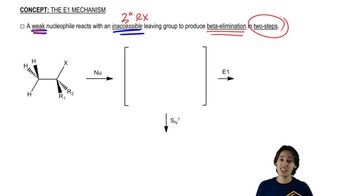
E1 Reaction Mechanism

The E1 reaction is a two-step elimination process where the first step involves the formation of a carbocation intermediate after the leaving group departs. The rate of an E1 reaction depends primarily on the stability of the carbocation formed; more stable carbocations (tertiary > secondary > primary) will react faster. This mechanism is favored in polar protic solvents that stabilize the carbocation.
Recommended video:
Guided course
08:09
Drawing the E1 Mechanism.

E2 Reaction Mechanism

The E2 reaction is a one-step elimination process where the base abstracts a proton while the leaving group departs simultaneously. This concerted mechanism requires a strong base and is influenced by sterics and the strength of the base. E2 reactions are favored in polar aprotic solvents and typically occur with more hindered substrates, where the base can effectively approach the proton to be removed.
Recommended video:
Guided course
09:36
Drawing the E2 Mechanism.

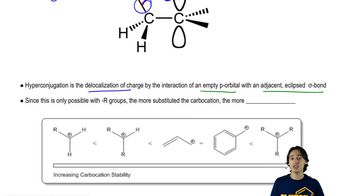
Carbocation Stability

Carbocation stability is a crucial factor in determining the rate of E1 reactions. Carbocations are classified based on their degree of substitution: tertiary carbocations are the most stable due to hyperconjugation and inductive effects, followed by secondary and primary. The stability of the carbocation influences the likelihood of its formation and thus the overall reaction rate in E1 mechanisms.
Recommended video:
Guided course
05:58
Determining Carbocation Stability