

When the following reactions are carried out under the same conditions, the rate constant for the first reaction (kH) is found to be 7 times greater than the rate constant for the second reaction (kD). What does that tell you about the mechanism of the reaction? (Hint: a C—D bond is 1.2 kcal/mol stronger than a C—H bond.)
Bruice 8th Edition
Ch. 9 - Substitution and Elimination Reactions of Alkyl Halides
Problem 90a. Which reacts faster in an E2 reaction: 3-bromocyclohexene or bromocyclohexane?
b. Which reacts faster in an E1 reaction?
Verified step by step guidance
Verified video answer for a similar problem:
Key Concepts
E2 Reaction Mechanism
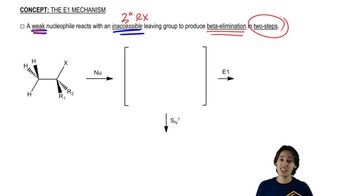
E1 Reaction Mechanism
Substrate Structure and Reactivity
Starting with an alkyl halide, how could the following compounds be prepared?
b. 1-methoxybutane
For each of the following reactions, draw the major elimination product; if the product can exist as stereoisomers, indicate which stereoisomer is obtained in greater yield.
e. 3-bromo-3-methylpentane + high concentration of CH3CH2O−
f. 3-bromo-3-methylpentane + CH3CH2OH
For each of the following reactions, draw the major elimination product; if the product can exist as stereoisomers, indicate which stereoisomer is obtained in greater yield.
c. trans-1-chloro-2-methylcyclohexane + high concentration of CH3O−
Starting with an alkyl halide, how could the following compounds be prepared?
a. 2-methoxybutane
For each of the following reactions, draw the major elimination product; if the product can exist as stereoisomers, indicate which stereoisomer is obtained in greater yield.
d. trans-1-chloro-3-methylcyclohexane + high concentration of CH3O−