Ch. 9 - Substitution and Elimination Reactions of Alkyl Halides
Bruice - Organic Chemistry 8th Edition
Bruice8th EditionOrganic ChemistryISBN: 9780135213711Not the one you use?Change textbook
Chapter 10, Problem 119b

cis-4-Bromocyclohexanol and trans-4-bromocyclohexanol form the same elimination product but a different substitution product when they react with HO.

b. Explain, by showing the mechanisms, why different substitution products are obtained.

Verified step by step guidance
1
Step 1: Analyze the stereochemistry of cis-4-bromocyclohexanol and trans-4-bromocyclohexanol. In cis-4-bromocyclohexanol, the hydroxyl group (-OH) and bromine (-Br) are on the same side of the cyclohexane ring, while in trans-4-bromocyclohexanol, they are on opposite sides.
Step 2: Understand the elimination reaction. Both cis and trans isomers undergo elimination to form the same alkene product. This occurs because the elimination follows the E2 mechanism, where the β-hydrogen is removed anti-periplanar to the leaving group (Br). The stereochemistry of the starting material does not affect the alkene product.
Step 3: Examine the substitution reaction for cis-4-bromocyclohexanol. The hydroxide ion (HO⁻) attacks the carbon bearing the bromine via an SN2 mechanism. In the cis isomer, the attack leads to inversion of configuration, resulting in a product where the hydroxyl group replaces bromine and remains cis to the original hydroxyl group.
Step 4: Examine the substitution reaction for trans-4-bromocyclohexanol. In the trans isomer, the hydroxide ion attacks the carbon bearing bromine via an SN2 mechanism. The inversion of configuration leads to a product where the hydroxyl group replaces bromine, forming a cyclic ether (epoxide) due to the proximity of the hydroxyl group.
Step 5: Summarize the difference in substitution products. The cis isomer forms a diol (two hydroxyl groups on the ring), while the trans isomer forms an epoxide. This difference arises due to the stereochemical arrangement of the substituents in the starting materials, which influences the mechanism and product formation.

Verified video answer for a similar problem:

This video solution was recommended by our tutors as helpful for the problem above.
Video duration:
6m
Was this helpful?

Key Concepts

Here are the essential concepts you must grasp in order to answer the question correctly.

Elimination Reactions

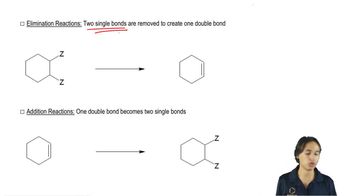
Elimination reactions involve the removal of a small molecule from a larger one, typically resulting in the formation of a double bond. In the context of alcohols reacting with bases like HO−, the reaction can lead to the formation of alkenes through the loss of water. The stereochemistry of the starting material influences the orientation of the double bond formed, which can affect the resulting products.
Recommended video:
Guided course
00:40
Recognizing Elimination Reactions.

Stereochemistry

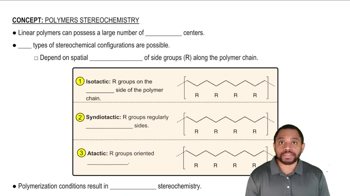
Stereochemistry refers to the spatial arrangement of atoms in molecules and how this affects their chemical behavior. In the case of cis- and trans-4-bromocyclohexanol, the different spatial arrangements lead to distinct pathways during substitution reactions. This can result in different products due to the influence of steric and electronic factors on the reaction mechanism.
Recommended video:
1:38
Polymer Stereochemistry Concept 1

Substitution Mechanisms

Substitution mechanisms, such as SN1 and SN2, describe how nucleophiles replace leaving groups in organic compounds. The mechanism chosen often depends on the structure of the substrate and the conditions of the reaction. In the case of cis- and trans-4-bromocyclohexanol, the stereochemistry affects the accessibility of the nucleophile to the electrophilic carbon, leading to different substitution products despite the same elimination product.
Recommended video:
Guided course
00:38
Intro to Substitution/Elimination Problems