Ch. 9 - Substitution and Elimination Reactions of Alkyl Halides
Bruice - Organic Chemistry 8th Edition
Bruice8th EditionOrganic ChemistryISBN: 9780135213711Not the one you use?Change textbook
Chapter 10, Problem 119a

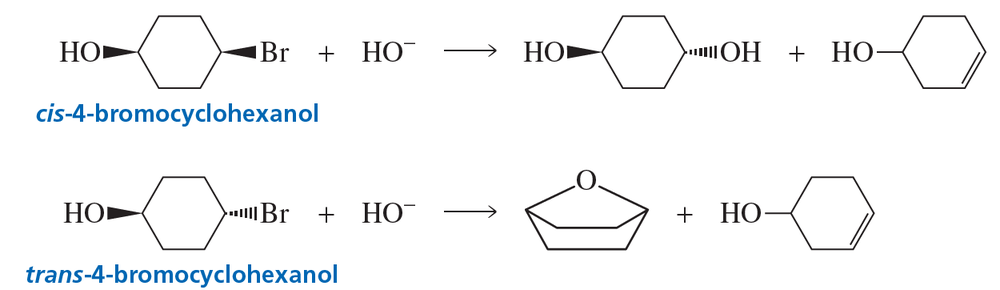
cis-4-Bromocyclohexanol and trans-4-bromocyclohexanol form the same elimination product but a different substitution product when they react with HO.
Chemical reactions of cis-4-bromocyclohexanol and trans-4-bromocyclohexanol with hydroxide ions.
a. Why do they form the same elimination product?

Verified step by step guidance
1
Step 1: Analyze the elimination reaction mechanism. Elimination reactions typically proceed via an E2 mechanism when a strong base like HO⁻ is present. In an E2 reaction, the base abstracts a proton from a β-carbon, and the leaving group departs simultaneously, forming a double bond.
Step 2: Consider the stereochemistry of the cis- and trans-4-bromocyclohexanol. In both cases, the β-hydrogen and the leaving group (Br) must be anti-periplanar (i.e., opposite and in the same plane) for the elimination to occur.
Step 3: Examine the chair conformations of cis- and trans-4-bromocyclohexanol. In the chair conformation, the anti-periplanar geometry is achievable for both cis and trans isomers because the β-hydrogen and bromine can adopt axial and equatorial positions, respectively, depending on the conformation.
Step 4: Recognize that the elimination product is the same for both isomers because the double bond forms between the same two carbons regardless of the initial stereochemistry of the reactant. The stereochemistry of the starting material does not affect the position of the double bond.
Step 5: Conclude that the same elimination product is formed because the anti-periplanar requirement is satisfied in both cases, and the reaction mechanism leads to the same alkene structure.

Verified video answer for a similar problem:

This video solution was recommended by our tutors as helpful for the problem above.
Video duration:
5m
Was this helpful?

Key Concepts

Here are the essential concepts you must grasp in order to answer the question correctly.

Elimination Reactions

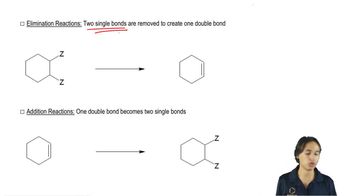
Elimination reactions involve the removal of atoms or groups from a molecule, resulting in the formation of a double bond. In the case of cis- and trans-4-bromocyclohexanol, both isomers can undergo elimination to form the same alkene product due to the ability of the hydroxide ion (OH−) to abstract a proton from adjacent carbon atoms, regardless of the stereochemistry of the starting material.
Recommended video:
Guided course
00:40
Recognizing Elimination Reactions.

Stereochemistry

Stereochemistry refers to the spatial arrangement of atoms in molecules and how this affects their chemical behavior. The cis and trans isomers of 4-bromocyclohexanol differ in the orientation of substituents around the cyclohexane ring, which influences their reactivity in substitution reactions but not in elimination reactions, as the formation of the double bond can occur from either configuration.
Recommended video:
1:38
Polymer Stereochemistry Concept 1

Substitution vs. Elimination

Substitution and elimination are two fundamental types of reactions in organic chemistry. While elimination leads to the formation of alkenes, substitution involves replacing one functional group with another. The different products formed by cis- and trans-4-bromocyclohexanol when reacting with OH− highlight how the stereochemistry can influence substitution pathways, leading to distinct products despite similar elimination outcomes.
Recommended video:
Guided course
00:38
Intro to Substitution/Elimination Problems