Ch. 9 - Substitution and Elimination Reactions of Alkyl Halides
Bruice - Organic Chemistry 8th Edition
Bruice8th EditionOrganic ChemistryISBN: 9780135213711Not the one you use?Change textbook
Chapter 10, Problem 110c,d

Draw the substitution products for each of the following SN2 reactions. If the ­products can exist as stereoisomers, show which stereoisomers are formed:
c. (3R,4R)-3-bromo-4-methylhexane + CH3O-
d. (3R,4S)-3-bromo-4-methylhexane + CH3O-

Verified step by step guidance
1
Step 1: Identify the type of substitution reaction. Since CH3O- is a strong nucleophile and a strong base, the reaction is likely to proceed via an SN2 mechanism. In SN2 reactions, the nucleophile attacks the carbon attached to the leaving group (bromine) from the opposite side, leading to inversion of configuration at the carbon center.
Step 2: Analyze the stereochemistry of the starting material for part (a). The compound (3R, 4R)-3-bromo-4-methylhexane has the bromine atom on the 3rd carbon in the R configuration and a methyl group on the 4th carbon in the R configuration. When CH3O- attacks the 3rd carbon, the configuration at this carbon will invert to S due to the backside attack characteristic of SN2 reactions.
Step 3: Draw the product for part (a). After the substitution, the bromine is replaced by the methoxy group (-OCH3), and the stereochemistry at the 3rd carbon is inverted to S. The 4th carbon retains its R configuration since it is not involved in the reaction.
Step 4: Analyze the stereochemistry of the starting material for part (b). The compound (3R, 4S)-3-bromo-4-methylhexane has the bromine atom on the 3rd carbon in the R configuration and a methyl group on the 4th carbon in the S configuration. When CH3O- attacks the 3rd carbon, the configuration at this carbon will invert to S due to the SN2 mechanism.
Step 5: Draw the product for part (b). After the substitution, the bromine is replaced by the methoxy group (-OCH3), and the stereochemistry at the 3rd carbon is inverted to S. The 4th carbon retains its S configuration since it is not involved in the reaction. If stereoisomers are possible, ensure to represent them clearly in the product structure.

Verified video answer for a similar problem:

This video solution was recommended by our tutors as helpful for the problem above.
Video duration:
3m
Was this helpful?

Key Concepts

Here are the essential concepts you must grasp in order to answer the question correctly.

Nucleophilic Substitution Reactions

Nucleophilic substitution reactions involve the replacement of a leaving group in a molecule by a nucleophile. In this context, the nucleophile is CH3O-, which attacks the carbon atom bonded to the bromine in the bromoalkane. Understanding the mechanism (either SN1 or SN2) is crucial, as it influences the stereochemistry of the products formed.
Recommended video:
Guided course
01:47
Nucleophiles and Electrophiles can react in Substitution Reactions.

Stereochemistry and Stereoisomers

Stereochemistry refers to the spatial arrangement of atoms in molecules and how this affects their chemical behavior. Stereoisomers are compounds that have the same molecular formula and connectivity but differ in the orientation of their atoms in space. In the given reactions, the stereochemistry of the starting materials will determine the types of stereoisomers produced, which may include enantiomers and diastereomers.
Recommended video:
1:38
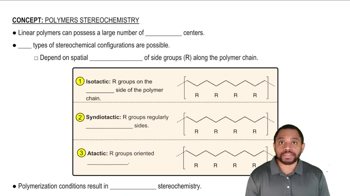
Polymer Stereochemistry Concept 1

Chirality and Optical Activity

Chirality is a property of a molecule that makes it non-superimposable on its mirror image, often due to the presence of a chiral center, typically a carbon atom with four different substituents. The presence of chirality in the products of the reactions can lead to optical activity, where the compounds can rotate plane-polarized light. Identifying chiral centers in the products is essential for determining the stereoisomers formed in the reactions.
Recommended video:
Guided course
08:17
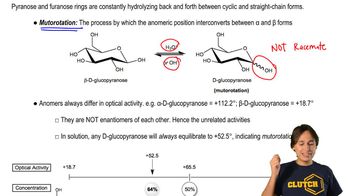
Mutorotation and Optical Activity
Related Practice
Textbook Question

Two bromoethers are obtained from the reaction of the following alkyl dihalide with methanol. Draw the structures of the ethers.

1250
views

Textbook Question

Draw the elimination products for each of the following E2 reactions; if the products can exist as stereoisomers, indicate which stereoisomers are obtained.

d. (2R,3R)-2-chloro-3-methylpentane + high concentration of CH3O-

1473
views
Textbook Question

The rate of the reaction of methyl iodide with quinuclidine was measured in nitrobenzene, and then the rate of the reaction of methyl iodide with ­triethylamine was measured in the same solvent. The concentration of the reagents was the same in both experiments.

c. Which alkyl halide has the larger kquinuclidine/ktriethylamine ratio?

1486
views
Textbook Question

Draw the substitution products for each of the following SN2 reactions. If the ­products can exist as stereoisomers, show which stereoisomers are formed:

a. (3S,4S)-3-bromo-4-methylhexane + CH3O-

b. (3S,4R)-3-bromo-4-methylhexane + CH3O-

958
views
Textbook Question

Draw the elimination products for each of the following E2 reactions; if the products can exist as stereoisomers, indicate which stereoisomers are obtained.

c. (2R,3S)-2-chloro-3-methylpentane + high concentration of CH3O-

1487
views
Textbook Question

Draw the elimination products for each of the following E2 reactions; if the products can exist as stereoisomers, indicate which stereoisomers are obtained.

a. (2S,3S)-2-chloro-3-methylpentane + high concentration of CH3O

b. (2S,3R)-2-chloro-3-methylpentane + high concentration of CH3O

726
views