Ch. 9 - Substitution and Elimination Reactions of Alkyl Halides
Bruice - Organic Chemistry 8th Edition
Bruice8th EditionOrganic ChemistryISBN: 9780135213711Not the one you use?Change textbook
Chapter 10, Problem 108c

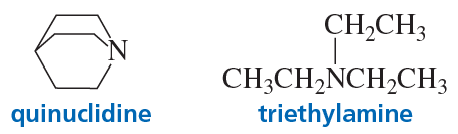
The rate of the reaction of methyl iodide with quinuclidine was measured in nitrobenzene, and then the rate of the reaction of methyl iodide with ­triethylamine was measured in the same solvent. The concentration of the reagents was the same in both experiments.
c. Which alkyl halide has the larger kquinuclidine/ktriethylamine ratio?
Chemical structures of quinuclidine and triethylamine, labeled for identification in a reaction context.

Verified step by step guidance
1
Step 1: Analyze the chemical structures provided in the image. Quinuclidine (1-azabicyclo[2.2.1]hepta-2,5-diene) is a bicyclic amine with a rigid structure and a highly nucleophilic nitrogen atom. Triisobutylamine is a tertiary amine with bulky isobutyl groups surrounding the nitrogen atom, which can hinder its nucleophilicity due to steric effects.
Step 2: Consider the reaction mechanism. The reaction of methyl iodide with amines typically proceeds via an SN2 mechanism, where the nucleophile attacks the electrophilic carbon of the methyl iodide, displacing the iodide ion. The rate of the reaction depends on the nucleophilicity of the amine and steric hindrance around the nucleophilic site.
Step 3: Compare the nucleophilicity of quinuclidine and triisobutylamine. Quinuclidine has a highly accessible nitrogen atom due to its rigid structure, making it a stronger nucleophile. In contrast, triisobutylamine has bulky substituents that create steric hindrance, reducing its ability to act as a nucleophile.
Step 4: Evaluate the kquinuclidine/ktriethylamine ratio. Since quinuclidine is more nucleophilic and less sterically hindered, it is expected to react faster with methyl iodide compared to triisobutylamine. This would result in a larger kquinuclidine/ktriethylamine ratio.
Step 5: Conclude that the alkyl halide (methyl iodide) will exhibit a larger kquinuclidine/ktriethylamine ratio when reacting with quinuclidine compared to triisobutylamine, due to the differences in nucleophilicity and steric hindrance between the two amines.

Verified video answer for a similar problem:

This video solution was recommended by our tutors as helpful for the problem above.
Video duration:
7m
Was this helpful?

Key Concepts

Here are the essential concepts you must grasp in order to answer the question correctly.

Nucleophilicity

Nucleophilicity refers to the ability of a nucleophile to donate an electron pair to an electrophile, such as an alkyl halide. In this context, quinuclidine is a stronger nucleophile than triethylamine due to its more basic nature and the presence of a nitrogen atom in a bicyclic structure, which can stabilize the negative charge better during the reaction.
Recommended video:
Guided course
08:27
Nucleophilic Addition

Reaction Rate Constants (k)

The rate constant (k) is a proportionality factor in the rate law of a chemical reaction, indicating how quickly a reaction occurs. The ratio of k values for different nucleophiles, such as kquinuclidine and ktriethylamine, provides insight into their relative reactivity. A higher ratio suggests that the reaction with quinuclidine proceeds faster than with triethylamine under the same conditions.
Recommended video:
2:29
Rates of Intramolecular Reactions Concept 1

Solvent Effects

The choice of solvent can significantly influence the rate of a reaction by stabilizing reactants, intermediates, or transition states. Nitrobenzene, a polar aprotic solvent, can enhance the nucleophilicity of quinuclidine while having a different effect on triethylamine. Understanding how solvents interact with reactants is crucial for predicting reaction outcomes and comparing reaction rates.
Recommended video:
Guided course
01:16
Identification of polarity in solvents
Related Practice
Textbook Question

Two bromoethers are obtained from the reaction of the following alkyl dihalide with methanol. Draw the structures of the ethers.

1250
views

Textbook Question

The rate of the reaction of methyl iodide with quinuclidine was measured in nitrobenzene, and then the rate of the reaction of methyl iodide with ­triethylamine was measured in the same solvent. The concentration of the reagents was the same in both experiments.

b. The same experiment was done using isopropyl iodide instead of methyl iodide. Which reaction had the larger rate constant?

1286
views
Textbook Question

In which solvent—ethanol or diethyl ether—would the equilibrium for the following SN2 reaction lie farther to the right?

950
views
Textbook Question

Draw the substitution products for each of the following SN2 reactions. If the ­products can exist as stereoisomers, show which stereoisomers are formed:

a. (3S,4S)-3-bromo-4-methylhexane + CH3O-

b. (3S,4R)-3-bromo-4-methylhexane + CH3O-

958
views
Textbook Question

The rate of the reaction of methyl iodide with quinuclidine was measured in nitrobenzene, and then the rate of the reaction of methyl iodide with ­triethylamine was measured in the same solvent. The concentration of the reagents was the same in both experiments.

a.Which reaction had the larger rate constant?

696
views
Textbook Question

Draw the substitution products for each of the following SN2 reactions. If the ­products can exist as stereoisomers, show which stereoisomers are formed:

c. (3R,4R)-3-bromo-4-methylhexane + CH3O-

d. (3R,4S)-3-bromo-4-methylhexane + CH3O-

863
views