10 g of dry ice (solid CO₂) is placed in a 10,000 cm3 container, then all the air is quickly pumped out and the container sealed. The container is warmed to 0°C, a temperature at which CO₂ is a gas. What is the gas pressure? Give your answer in atm. The gas then undergoes an isothermal compression until the pressure is 3.0 atm, immediately followed by an isobaric compression until the volume is 1000 cm3.
Verified step by step guidance
1
Step 1: Calculate the number of moles of CO₂. Use the formula for moles: \( n = \frac{m}{M} \), where \( m \) is the mass of CO₂ (10 g) and \( M \) is the molar mass of CO₂ (44 g/mol).
Step 2: Use the ideal gas law to calculate the initial pressure of the gas. The ideal gas law is \( PV = nRT \), where \( P \) is pressure, \( V \) is volume (10,000 cm³ converted to liters), \( n \) is the number of moles, \( R \) is the gas constant (0.0821 L·atm/(mol·K)), and \( T \) is the temperature in Kelvin (0°C = 273 K). Rearrange the equation to solve for \( P \): \( P = \frac{nRT}{V} \).
Step 3: For the isothermal compression, use the relationship \( P_1V_1 = P_2V_2 \) (Boyle's Law). Here, \( P_1 \) and \( V_1 \) are the initial pressure and volume, and \( P_2 \) and \( V_2 \) are the final pressure (3.0 atm) and the unknown volume after the isothermal compression. Solve for \( V_2 \): \( V_2 = \frac{P_1V_1}{P_2} \).
Step 4: For the isobaric compression, the pressure remains constant at 3.0 atm. The final volume is given as 1000 cm³ (or 1.0 L). Use the ideal gas law again to calculate the final temperature \( T_f \) after the isobaric compression. Rearrange the ideal gas law to solve for \( T_f \): \( T_f = \frac{P_fV_f}{nR} \), where \( P_f \) is the final pressure, \( V_f \) is the final volume, \( n \) is the number of moles, and \( R \) is the gas constant.
Step 5: Summarize the process. First, calculate the initial pressure using the ideal gas law. Then, determine the intermediate volume after the isothermal compression using Boyle's Law. Finally, calculate the final temperature after the isobaric compression using the ideal gas law. Ensure all units are consistent throughout the calculations.
Verified video answer for a similar problem:
This video solution was recommended by our tutors as helpful for the problem above
Video duration:
6m
Play a video:
0 Comments
Key Concepts
Here are the essential concepts you must grasp in order to answer the question correctly.
Ideal Gas Law
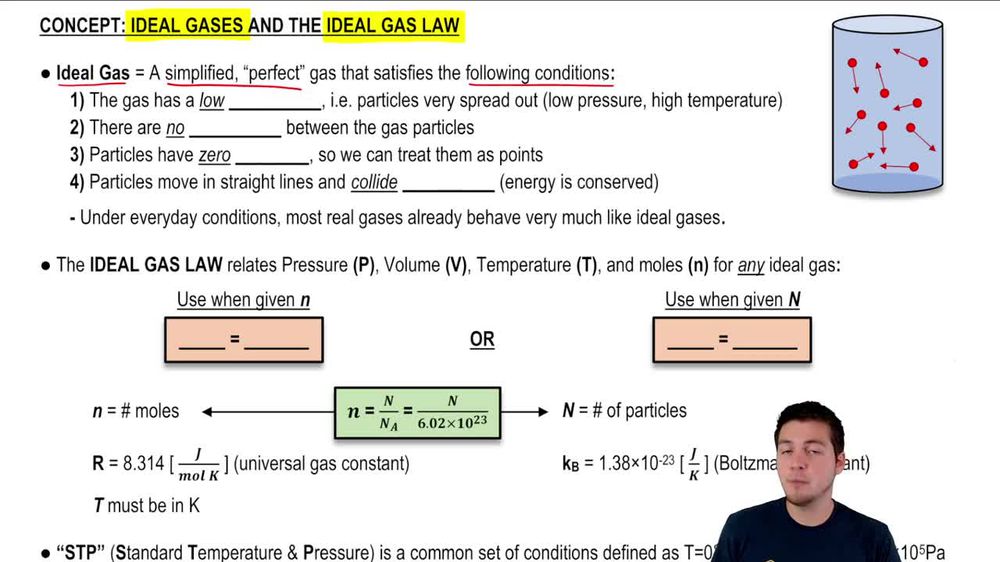
The Ideal Gas Law relates the pressure, volume, temperature, and number of moles of a gas through the equation PV = nRT. In this context, it helps determine the pressure of CO₂ gas in the container at 0°C, where n is the number of moles of CO₂, R is the ideal gas constant, and T is the absolute temperature in Kelvin.
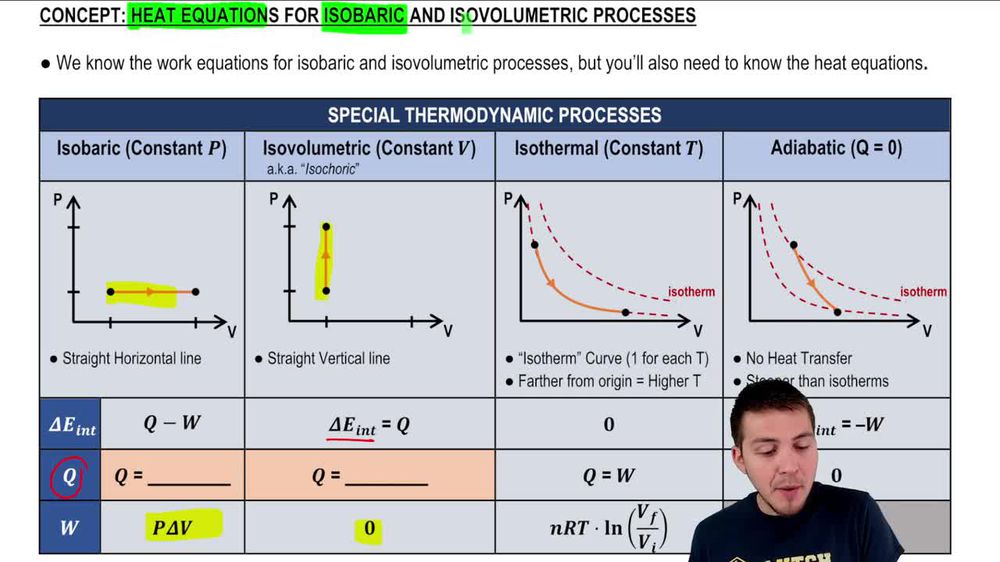
An isothermal process occurs when a gas is compressed or expanded at a constant temperature. During this process, the internal energy of the gas remains constant, and any work done on or by the gas results in heat exchange with the surroundings. This concept is crucial for understanding how the gas pressure changes during the isothermal compression phase described in the question.
An isobaric process is one in which the pressure remains constant while the volume and temperature of the gas change. In this scenario, the gas undergoes an isobaric compression, meaning that as the volume decreases to 1000 cm³, the pressure will remain at 3.0 atm, allowing for calculations of temperature changes and the behavior of the gas under these conditions.