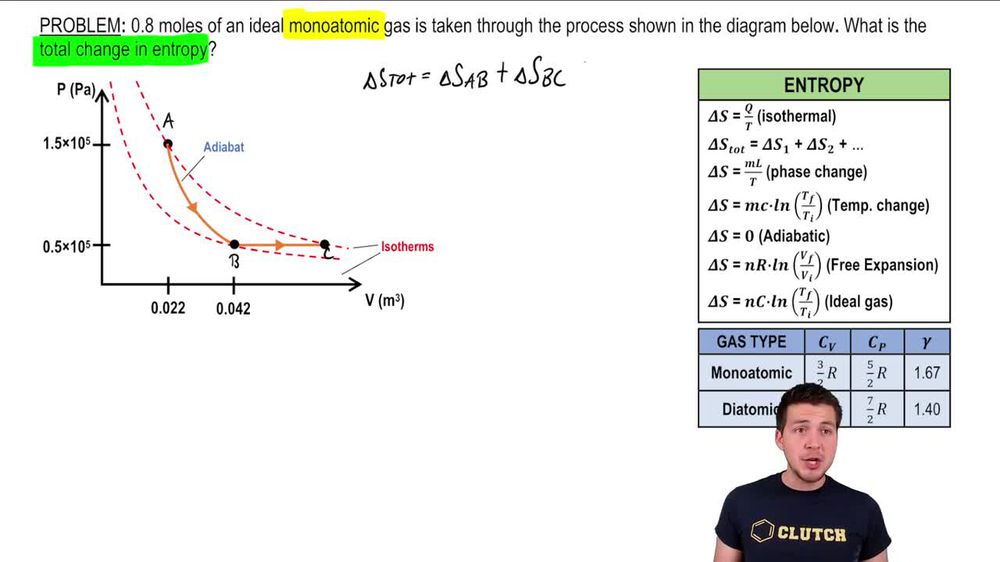
A container of gas at 2.0 atm pressure and 127°C is compressed at constant temperature until the volume is halved. It is then further compressed at constant pressure until the volume is halved again. Show this process on a pV diagram.
Verified step by step guidance
1
Step 1: Understand the problem. The gas undergoes two processes: (1) an isothermal compression where the volume is halved at constant temperature, and (2) an isobaric compression where the volume is halved again at constant pressure. We need to represent these processes on a pressure-volume (pV) diagram.
Step 2: Recall the relationship for an isothermal process. For an ideal gas undergoing an isothermal process, the pressure and volume are related by Boyle's Law: . Since the volume is halved, the pressure will double during this step.
Step 3: Represent the isothermal process on the pV diagram. Start with the initial state (p = 2.0 atm, V = V₀). As the volume is halved (V = V₀/2), the pressure increases to 4.0 atm. Plot this curve as a hyperbolic line on the pV diagram, since pV = constant for an isothermal process.
Step 4: Recall the relationship for an isobaric process. For an isobaric process, the pressure remains constant while the volume changes. In this case, the volume is halved again (V = V₀/4), but the pressure remains at 4.0 atm.
Step 5: Represent the isobaric process on the pV diagram. From the endpoint of the isothermal process (p = 4.0 atm, V = V₀/2), draw a horizontal line to the new volume (V = V₀/4) while keeping the pressure constant at 4.0 atm. This completes the pV diagram for the described process.
Verified video answer for a similar problem:
This video solution was recommended by our tutors as helpful for the problem above
Video duration:
9m
Play a video:
0 Comments
Key Concepts
Here are the essential concepts you must grasp in order to answer the question correctly.
Ideal Gas Law
The Ideal Gas Law relates the pressure, volume, and temperature of an ideal gas through the equation PV = nRT. This law is fundamental in understanding how gases behave under varying conditions. In this scenario, it helps explain the relationship between pressure and volume during the compression processes described.
An isothermal process occurs when a gas is compressed or expanded at a constant temperature. During this process, the internal energy of the gas remains constant, and any work done on or by the gas results in heat exchange with the surroundings. This concept is crucial for the first part of the question, where the gas is compressed at constant temperature.
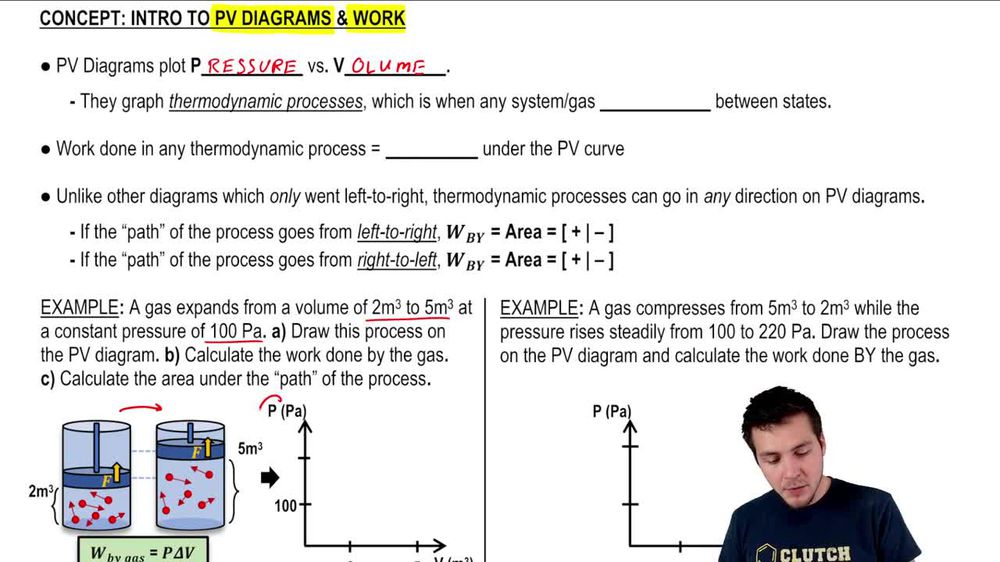
A pV diagram is a graphical representation of the relationship between pressure (p) and volume (V) for a gas. It visually illustrates the changes in state of the gas during different processes, such as isothermal and isobaric. Understanding how to plot these processes on a pV diagram is essential for analyzing the behavior of the gas during the described compressions.