 Back
BackElectromagnetic Induction and Electrical Machines: Motors and Generators
Study Guide - Smart Notes
 Tailored notes based on your materials, expanded with key definitions, examples, and context.
Electromagnetic Induction and Electrical Machines
Introduction to Electrical Machines
Electrical machines are devices that convert energy between electrical and mechanical forms. The two main types are electric motors and electric generators. Both operate on the principles of electromagnetism and share similar components, but their functions are opposite.
Electric Motor: Converts electrical energy into mechanical energy.
Electric Generator: Converts mechanical energy into electrical energy.
Device | Function |
|---|---|
Electric Motor | Uses electricity to produce motion |
Electric Generator | Uses motion to produce electricity |
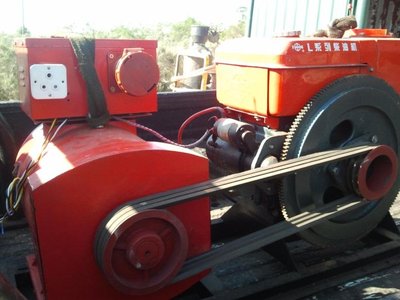
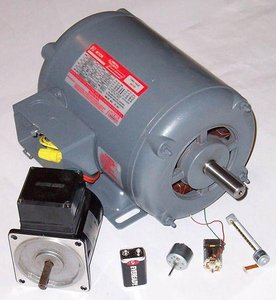
Key Components:
Magnets
Conducting coil (wire)
Slip or split rings (for current transfer)
Principle: A changing magnetic field induces an electric field, and magnetic fields interact with each other.
Main Difference: Motors use electricity to create motion, while generators use motion to create electricity.
Electromagnetic Induction
Electromagnetic induction is the process of generating an electromotive force (emf) or voltage across a conductor when it experiences a changing magnetic field. This is the fundamental principle behind both motors and generators.
Faraday's Law of Electromagnetic Induction: The induced emf in a coil is directly proportional to the rate of change of magnetic flux through the coil.
Mathematical Expression:
= induced emf (V)
= number of turns in the coil
= change in magnetic flux (Wb)
= time interval (s)
Magnetic Flux (): The total magnetic field passing through a given area.
= magnetic field strength (T, Tesla)
= area perpendicular to the field (m2)

Lenz's Law: The direction of the induced current is such that it opposes the change in magnetic flux that caused it.
Right Hand Rule
The right hand rule helps determine the direction of the induced current or magnetic field:
For a straight wire: Point your thumb in the direction of current; your curled fingers show the direction of the magnetic field.
For a coil: Curl your fingers in the direction of current; your thumb points to the north pole of the coil.
Alternating Current (AC) vs. Direct Current (DC)
Current induced by electromagnetic induction can be either alternating or direct:
Alternating Current (AC): The direction of current reverses periodically. Produced by generators in power stations.
Direct Current (DC): The current flows in one direction only. Produced by batteries.
Factors Affecting Induced emf
The magnitude of the induced emf (and thus the current) can be increased by:
Increasing the speed of movement of the magnet or coil
Using a stronger magnet
Increasing the number of turns in the coil
Worked Example: Induced emf in a Coil
Problem: A circular coil of radius 3 cm (0.03 m) with 150 turns and resistance 10 Ω is placed perpendicular to a magnetic field of 3.8 T. The coil is pulled out of the field in 0.2 s. Calculate:
The change in magnetic flux
The induced emf
The induced current
Solution:
Magnetic flux in the field: Magnetic flux outside the field: $0\Delta \Phi = 0 - 0.011 = -0.011$ Wb
Induced emf: V
Induced current: A
Applications of Electromagnetic Induction
Electric Guitars: Use magnetic pickups to convert string vibrations into electrical signals.
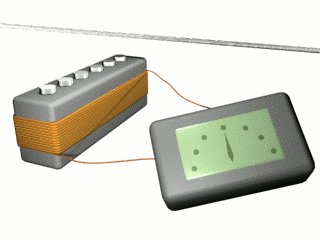
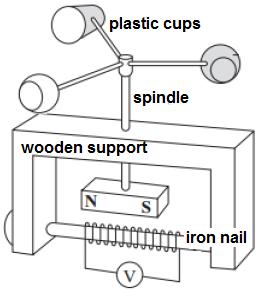
Wind Speed Gauges: Use rotating magnets and coils to generate a voltage proportional to wind speed.
Key Concepts and Definitions
Faraday's Law: The magnitude of the emf induced in a coil is proportional to the rate of change of magnetic flux.
Electromagnetic Induction: The process of generating electricity by changing the magnetic field acting on a conductor.
Electric Motor: Converts electrical energy into mechanical energy.
Electric Generator: Converts mechanical energy into electrical energy.
Alternating Current (AC): Electric charge periodically reverses direction.
Direct Current (DC): Electric charge flows in one direction only.
Summary Table: Increasing Induced emf
Method | Effect |
|---|---|
Increase speed of movement | Greater rate of change of flux |
Use stronger magnet | Increases magnetic field strength (B) |
Increase number of coil turns | Increases total induced emf |
Practice Questions
Explain what happens when a magnet is pushed into a coil in terms of magnetic field, reaction of the coil, current, and direction of current.
Is the principle of inducing current by a changing magnetic field fundamental to electric motors or generators? Explain.
Name two conditions for the induction of a current.
Name three ways to increase the induced emf or current in a closed circuit.
Which statements describe alternating current (AC)?
In a coal-fired power plant, what type of energy conversion occurs?
If an electric current flows into the page, what is the direction of the magnetic field?
If the magnetic flux is 0.02 Wb, determine the magnetic field strength given the area.
Explain how a wind speed gauge produces a voltage reading and how to increase its sensitivity.
Additional info:
Review the exercises and definitions for mastery.
Continue learning with further lessons on AC generators and related topics.
