 Back
BackInfinite Limits and Their Properties
Study Guide - Smart Notes
 Tailored notes based on your materials, expanded with key definitions, examples, and context.
Limits & Continuity
Infinite Limits
In calculus and precalculus, infinite limits describe the behavior of a function as the input approaches a certain value and the output increases or decreases without bound. These limits help us understand vertical asymptotes and the unbounded growth of functions near specific points.
Definition: Let f be a function defined on both sides of a (except possibly at a itself). We say that the limit of f(x) as x approaches a is infinity if the values of f(x) can be made arbitrarily large (positive or negative) by taking x sufficiently close to a (but not equal to a).
This means that as x approaches a, f(x) increases without bound.
One-Sided Infinite Limits
We can also consider the behavior of a function as x approaches a from the left or right:
Left-hand limit:
Right-hand limit:
For example:
Examples of Infinite Limits
Example 1:
Example 2:
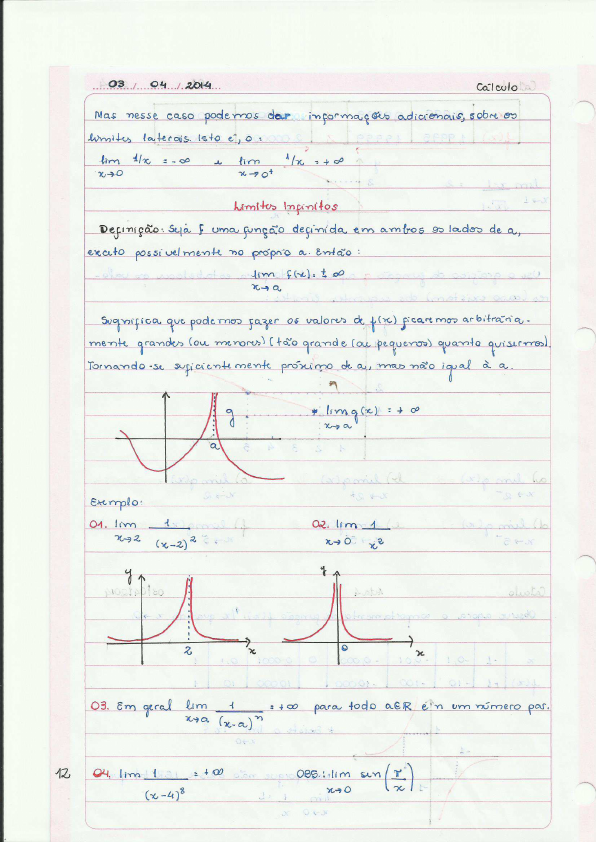
These graphs show that as x approaches the value where the denominator is zero, the function grows without bound, indicating a vertical asymptote.
General Property of Infinite Limits
In general, for all real numbers a and even positive integers n.
Special Cases and Other Limits
Example 3:
Oscillating Limit: (This is a classic limit, not infinite, but important for understanding behavior near zero.)
Additional info: Infinite limits are closely related to the concept of vertical asymptotes in graphing rational functions. When the denominator of a rational function approaches zero and the numerator does not, the function's value increases or decreases without bound near that point.
