 Back
BackAfrican Americans Today: Social, Economic, and Political Realities
Study Guide - Smart Notes
 Tailored notes based on your materials, expanded with key definitions, examples, and context.
African Americans Today
Introduction
This chapter examines the contemporary experiences of African Americans in the United States, focusing on education, economics, family life, housing, criminal justice, health care, and political participation. Each section highlights both progress and persistent challenges, providing a sociological perspective on inequality and social change.
Education
Major Educational Issues Facing African Americans
Educational Attainment Gap: The gap between White and Black students in college degree attainment has not narrowed significantly in recent years. While African Americans have made progress, their current college completion rates are similar to those of White Americans in the mid-1980s.
School Environment: De facto segregation and the existence of "apartheid schools" (schools with overwhelmingly one-race populations) persist. Cultural pressures such as the "acting White" accusation can discourage academic achievement.
Higher Education Barriers: Factors such as reductions in financial aid, increased academic standards without adequate support, economic pressures, negative publicity about affirmative action, and racial incidents on predominantly White campuses hinder progress.
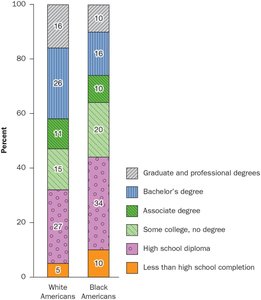
Example: Figure 8.1 shows the distribution of educational attainment by race, highlighting disparities in degree completion.
The Economic Picture
Income, Wealth, and Employment
Relative Deprivation: Despite improvements, African Americans remain disadvantaged compared to Whites on most economic indicators.
The Black Middle Class: About one-fifth of Black households are middle class or higher, but the majority remain lower income. Black income has increased, but the wealth gap with Whites persists.
Employment: African Americans experience higher unemployment and underemployment rates and are underrepresented in high-status, high-paying occupations.
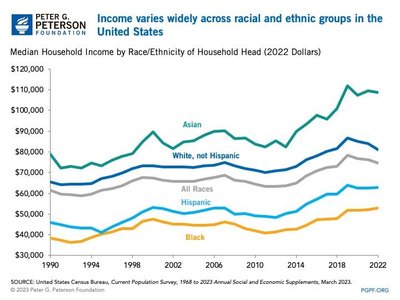
Example: Median household income for Black Americans remains lower than for other groups, as shown in the income trends chart.
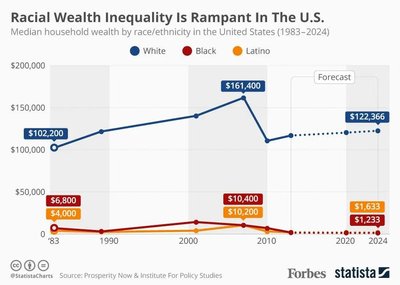
Example: Wealth inequality is even more pronounced than income inequality, with Black households holding a fraction of the wealth of White households.
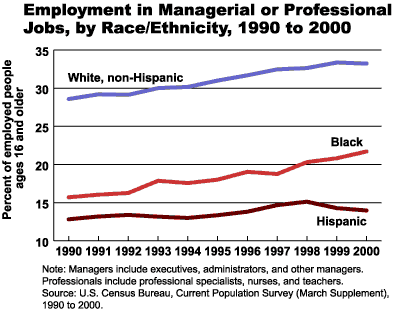
Example: Black Americans are less likely to be employed in managerial or professional jobs compared to White Americans.
Legacy of Slavery and Reparations
Historical Context and Current Debates
Reparations: The U.S. has provided reparations to other groups (e.g., Native Americans, Japanese Americans, Holocaust survivors), but not to African Americans for slavery.
Barriers to Wealth Accumulation: Historical and ongoing policies (e.g., redlining, employment discrimination) have prevented Black Americans from accumulating wealth.
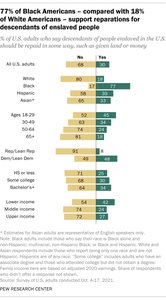
Example: Support for reparations varies significantly by race, with a majority of Black Americans in favor.
Family Life
Strengths and Challenges
Challenges: Single-parent families are common among African Americans, but not universal. Economic pressures and broader societal trends contribute to family instability.
Strengths: African American families often demonstrate strong kinship bonds, adaptability, work orientation, achievement orientation, and religious commitment.
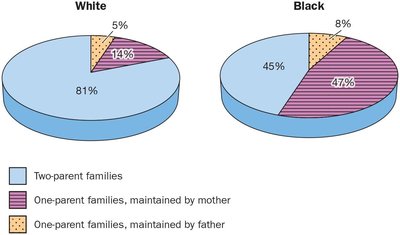
Example: Figure 8.3 compares the prevalence of single-parent and two-parent families among White and Black Americans.
Housing
Homeownership and Residential Segregation
Homeownership Gap: As of 2023, 75% of White households owned their homes compared to 45% of African American households.
Residential Segregation: Practices such as refusing to sell or rent to minorities, steering by real estate agents, ineffective enforcement of anti-bias laws, and discriminatory lending contribute to segregation.
Zoning Laws: Local regulations can indirectly exclude less affluent (often minority) residents by requiring expensive building materials or other barriers.

Example: Zoning laws can reinforce segregation by making housing unaffordable for many African Americans.
Criminal Justice
Disparities and Social Movements
Overrepresentation: African Americans are disproportionately represented in the criminal justice system, making up 38% of jail inmates but only about 12% of the population.
Lifetime Incarceration Risk: 1 in 3 Black men can expect to go to prison, compared to 1 in 16 White men.
Differential Justice: Whites are often treated more leniently at every stage of the criminal justice process.
Victim Discounting: Crimes against Black victims are often seen as less significant.
Social Movements: The #BlackLivesMatter movement arose in response to police brutality and differential treatment of Black Americans.
Health Care
Health Disparities and Access
Higher Disease and Mortality Rates: Black Americans have higher rates of heart disease, diabetes, cancer, and other illnesses compared to Whites.
Impact of COVID-19: Life expectancy for Black and Hispanic Americans dropped more sharply during the pandemic.
Barriers to Care: Distrust of the medical system, lack of insurance, and "medical apartheid" (separate and unequal care) persist.
Politics
Political Participation and Representation
Voter Engagement: African Americans have high rates of voter participation; in 2012, Black voter turnout exceeded that of White non-Hispanics for the first time.
Barriers to Political Advancement: Black politicians often face challenges in moving from local to statewide office, and are often seen only as representatives of the Black community.
Voter Suppression: Tactics such as strict ID requirements, reduced polling places, and limits on early voting disproportionately affect Black voters.
Representation: The Black Congressional Caucus had 58 members as of 2023.
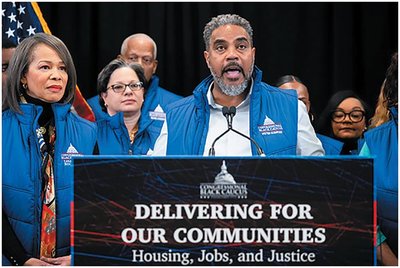
Example: The Black Congressional Caucus advocates for the interests of African Americans in Congress.
