 Back
BackCrime, Deviance, Institutional Racism, and Precarity: Indigenous and Sociological Perspectives
Study Guide - Smart Notes
 Tailored notes based on your materials, expanded with key definitions, examples, and context.
Crime, Deviance, and the Law: An Indigenous Perspective
Introduction
This section explores the sociological concepts of crime, deviance, and the law, focusing on the experiences of Indigenous peoples in Canada. It highlights the impact of colonization, institutional racism, and the need for Indigenous perspectives in understanding justice.
Defining Crime, Deviance, and the Law
Crime: An act that violates the law and is punishable by the state. In Western societies, crime is often seen as an offense against the state.
Deviance: Behavior that violates social norms but is not necessarily criminal (e.g., having tattoos).
Law: A system of rules created and enforced by social or governmental institutions to regulate behavior.
Indigenous Perspective: Crime is viewed as harm between individuals and communities, emphasizing restoration and healing rather than punishment.
Example: Indigenous hunting and fishing rights are often criminalized under Canadian law, despite being traditional practices.
Colonization and Institutional Racism
Colonization: The process by which a dominant group imposes its culture, laws, and social structures on another group, often leading to marginalization and loss of traditional practices.
Institutional Racism: Systemic oppression embedded in laws, policies, and practices that disadvantage racial minorities. Key indicators include cultural support, legal codification, and exclusion from participation.
Racial Prejudice vs. Institutional Racism: Prejudice is an attitude; institutional racism requires power to enforce discriminatory practices.
Example: The overrepresentation of Indigenous peoples in Canadian prisons is a result of institutional racism, not just individual prejudice.
Evidence of Institutional Racism
Indigenous peoples face harsher sentences, exclusion from juries, and racial profiling.
Colonial policies banned Indigenous ceremonies (e.g., Potlatch, Sundance) and imposed residential schools, leading to cultural disruption and social dysfunction.
High rates of incarceration, missing and murdered Indigenous women and girls, and systemic poverty are direct outcomes of colonial and racist policies.
Indigenous Perspectives on Justice
Justice is seen as a process of healing, restoration, and community involvement.
Traditional practices include healing circles and sentencing circles, focusing on repairing harm and restoring relationships.
Western punitive justice systems are contrasted with Indigenous restorative approaches.
The Four Directions Model: An Indigenous-Based Holistic Research Methodology
The Four Directions Model is a holistic framework used by Swampy Cree Elders to understand justice, emphasizing the mental, physical, emotional, and spiritual realms of being.
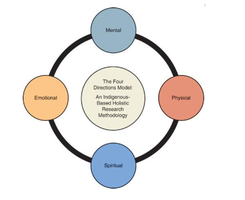
Mental Realm: Focuses on understanding the reasons behind wrongful behavior and emphasizes healing and personal growth.
Physical Realm: Stresses accountability and the need for offenders to take responsibility for their actions, often through restorative practices.
Emotional Realm: Involves community support, empathy, and the importance of forgiveness and reconciliation.
Spiritual Realm: Highlights the role of spirituality and ceremonies in the healing process.
Example: Offenders may participate in ceremonies or seek counsel from Elders to restore balance and harmony.
Summary of Indigenous Justice
Indigenous justice prioritizes healing, restoration, and community well-being over punishment.
Material compensation may be used to repair harm, but the focus remains on restoring relationships and balance.
Colonial justice systems have disrupted traditional practices, but Indigenous approaches offer valuable lessons for improving justice for all communities.
Precarity and Precarious Employment
Introduction
This section examines the rise of precarious employment in Canada, its forms, and its consequences for individuals and communities. Precarity is understood as a public issue affecting social, economic, and personal well-being.
Defining Precarity and Precarious Employment
Precarity: A state of insecurity and instability in employment and daily life.
Precarious Employment: Jobs that are temporary, part-time, low-paying, and lack benefits or job security.
Standard Employment Relationship (SER): Full-time, permanent work with benefits and protections, which is increasingly being replaced by precarious arrangements.
Example: Temporary agency work, involuntary part-time jobs, and contract positions without benefits.
Trends in Precarious Employment
Growth in temporary and part-time work across all sectors, including traditionally stable professions like academia and healthcare.
Precarity affects workers of all social classes, but disproportionately impacts women, racialized groups, immigrants, youth, and older adults.
Forms of Precarious Employment
Full-time work with low wages and few benefits
Involuntary part-time work (less than 30 hours per week)
Temporary, seasonal, or contract work
Table: Rate of Involuntary Part-Time Work by Sex and Age (1997–2007)
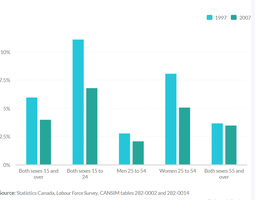
Interpretation: The chart shows that women, especially those aged 25–54, are more likely to be involuntarily employed part-time compared to men. The rate is highest among youth (15–24).
Intersectionality in Precarious Employment
Gender: Women are overrepresented in precarious jobs, earn less, and have fewer benefits.
Race/Ethnicity: Racialized workers, especially recent immigrant women, are more likely to be in low-wage, non-unionized, and precarious jobs.
Age: Young and older workers are more likely to be in part-time or temporary work.
Consequences of Precarious Employment (The Precarity Penalty)
Lower income and financial instability
Deskilling: Loss of skills due to lack of training and reliance on automation
Delayed life milestones: Difficulty forming relationships and starting families
Social isolation: Reduced community participation and support networks
Poor mental and physical health
Policy Responses and Social Movements
Recent legislative changes (e.g., Ontario's Fair Workplace and Better Jobs Act) aimed to improve protections for precarious workers, but many reforms have been repealed.
The "Fight for Fifteen" movement advocates for higher minimum wages, equal pay, paid leave, and the right to unionize.
Summary
Precarious employment is a growing feature of the Canadian labour market, affecting economic, social, and personal well-being.
Its impacts are multidimensional and intersectional, requiring comprehensive policy and community responses.
