The following data represent the time (in minutes) students spent working their Section 1.1 homework from Sullivan’s College Algebra course (based on time logged into MyLabMath). Draw a stem-and-leaf diagram of the data and comment on the shape of the distribution.
Verified step by step guidance
1
Step 1: Organize the data by separating each value into a 'stem' and a 'leaf'. The 'stem' consists of all but the last digit, and the 'leaf' is the last digit. For example, for 46, the stem is 4 and the leaf is 6; for 110, the stem is 11 and the leaf is 0.
Step 2: List the stems in ascending order vertically. For each stem, write the corresponding leaves in ascending order horizontally next to it. This forms the stem-and-leaf plot, which visually represents the distribution of the data.
Step 3: After constructing the stem-and-leaf plot, examine the shape of the distribution by observing the spread and concentration of leaves across the stems. Look for patterns such as symmetry, skewness, gaps, or clusters.
Step 4: Identify the center of the distribution by noting where most leaves are concentrated. Also, observe if the distribution is skewed to the left (longer tail on the lower values) or to the right (longer tail on the higher values), or if it appears roughly symmetric.
Step 5: Summarize your observations about the shape of the distribution based on the stem-and-leaf plot, commenting on whether it is symmetric, skewed, has outliers, or any other notable features.
Verified video answer for a similar problem:
This video solution was recommended by our tutors as helpful for the problem above
Video duration:
2m
Play a video:
0 Comments
Key Concepts
Here are the essential concepts you must grasp in order to answer the question correctly.
Stem-and-Leaf Diagram
A stem-and-leaf diagram is a method of displaying quantitative data that organizes numbers by place value. The 'stem' represents the leading digit(s), while the 'leaf' shows the last digit. This format helps visualize the distribution and retains the original data values, making it easier to identify patterns and outliers.
The shape of a distribution describes how data values are spread and clustered, such as symmetric, skewed, or uniform. Analyzing the shape helps understand the data’s central tendency, variability, and presence of outliers. For example, a right-skewed distribution has a longer tail on the right side, indicating some larger values.
Organizing raw data into a visual format like a stem-and-leaf plot aids in interpreting key features such as central values, spread, and gaps. Proper interpretation involves summarizing these features to draw conclusions about the dataset, which is essential for making informed decisions or further statistical analysis.

 2:43 minutes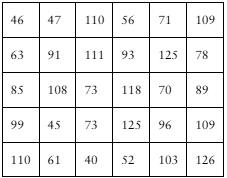
 Verified step by step guidance
 06:23
06:23