
A stemplot contains the row 2|0024555789. List the data points displayed in this row.
Table of contents
- 1. Intro to Stats and Collecting Data1h 14m
- 2. Describing Data with Tables and Graphs1h 56m
- 3. Describing Data Numerically2h 5m
- 4. Probability2h 17m
- 5. Binomial Distribution & Discrete Random Variables3h 6m
- 6. Normal Distribution and Continuous Random Variables2h 11m
- 7. Sampling Distributions & Confidence Intervals: Mean3h 23m
- Sampling Distribution of the Sample Mean and Central Limit Theorem19m
- Distribution of Sample Mean - ExcelBonus23m
- Introduction to Confidence Intervals15m
- Confidence Intervals for Population Mean1h 18m
- Determining the Minimum Sample Size Required12m
- Finding Probabilities and T Critical Values - ExcelBonus28m
- Confidence Intervals for Population Means - ExcelBonus25m
- 8. Sampling Distributions & Confidence Intervals: Proportion2h 10m
- 9. Hypothesis Testing for One Sample5h 8m
- Steps in Hypothesis Testing1h 6m
- Performing Hypothesis Tests: Means1h 4m
- Hypothesis Testing: Means - ExcelBonus42m
- Performing Hypothesis Tests: Proportions37m
- Hypothesis Testing: Proportions - ExcelBonus27m
- Performing Hypothesis Tests: Variance12m
- Critical Values and Rejection Regions28m
- Link Between Confidence Intervals and Hypothesis Testing12m
- Type I & Type II Errors16m
- 10. Hypothesis Testing for Two Samples5h 37m
- Two Proportions1h 13m
- Two Proportions Hypothesis Test - ExcelBonus28m
- Two Means - Unknown, Unequal Variance1h 3m
- Two Means - Unknown Variances Hypothesis Test - ExcelBonus12m
- Two Means - Unknown, Equal Variance15m
- Two Means - Unknown, Equal Variances Hypothesis Test - ExcelBonus9m
- Two Means - Known Variance12m
- Two Means - Sigma Known Hypothesis Test - ExcelBonus21m
- Two Means - Matched Pairs (Dependent Samples)42m
- Matched Pairs Hypothesis Test - ExcelBonus12m
- Two Variances and F Distribution29m
- Two Variances - Graphing CalculatorBonus16m
- 11. Correlation1h 24m
- 12. Regression3h 33m
- Linear Regression & Least Squares Method26m
- Residuals12m
- Coefficient of Determination12m
- Regression Line Equation and Coefficient of Determination - ExcelBonus8m
- Finding Residuals and Creating Residual Plots - ExcelBonus11m
- Inferences for Slope31m
- Enabling Data Analysis ToolpakBonus1m
- Regression Readout of the Data Analysis Toolpak - ExcelBonus21m
- Prediction Intervals13m
- Prediction Intervals - ExcelBonus19m
- Multiple Regression - ExcelBonus29m
- Quadratic Regression15m
- Quadratic Regression - ExcelBonus10m
- 13. Chi-Square Tests & Goodness of Fit2h 21m
- 14. ANOVA2h 29m
2. Describing Data with Tables and Graphs
Stemplots (Stem-and-Leaf Plots)
Problem 2.2.21
Textbook Question
Graphing Data Sets In Exercises 17–32, organize the data using the indicated type of graph. Describe any patterns.
Highest-Paid Athletes Use a stem-and-leaf plot that has two rows for each stem to display the data, which represent the incomes (in millions) of the top 30 highest-paid athletes. (Source: Forbes Media LLC)
39 42 41 45 48 48 106 45 88 54 61 37 62 74 40
47 56 57 105 96 37 48 41 64 52 47 45 59 49 104
Verified step by step guidance1
Step 1: Understand the stem-and-leaf plot. A stem-and-leaf plot is a way to organize numerical data by splitting each value into a 'stem' (all but the last digit) and a 'leaf' (the last digit). For this problem, we will use two rows for each stem to better display the data.
Step 2: Sort the data in ascending order. This will make it easier to organize the values into the stem-and-leaf plot. The sorted data is: 37, 37, 39, 41, 41, 42, 45, 45, 45, 47, 47, 48, 48, 48, 49, 52, 54, 56, 57, 59, 61, 62, 64, 74, 88, 96, 104, 105, 106.
Step 3: Define the stems and leaves. The 'stem' will represent the tens place of each number, and the 'leaf' will represent the ones place. For example, the number 37 will have a stem of 3 and a leaf of 7. Since we are using two rows per stem, the first row will include leaves from 0–4, and the second row will include leaves from 5–9.
Step 4: Organize the data into the stem-and-leaf plot. For each stem, place the corresponding leaves in the appropriate row. For example, for the stem '3', the first row will include the leaf '7' (from 37), and the second row will include another '7' (from the second 37) and '9' (from 39). Repeat this process for all stems.
Step 5: Analyze the plot for patterns. Once the stem-and-leaf plot is complete, look for any trends or clusters in the data. For example, you might notice that most of the incomes are concentrated in the 40s and 50s, with a few outliers in the 100s. This can help describe the distribution of the data.
Verified video answer for a similar problem:This video solution was recommended by our tutors as helpful for the problem above
Video duration:
2mPlay a video:
0 Comments
Key Concepts
Here are the essential concepts you must grasp in order to answer the question correctly.
Stem-and-Leaf Plot
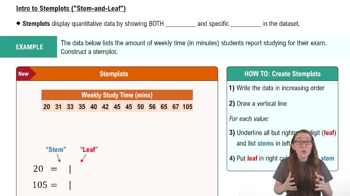
A stem-and-leaf plot is a method of displaying quantitative data in a graphical format, similar to a histogram, to retain the original data values while showing their distribution. Each number is split into a 'stem' (the leading digit or digits) and a 'leaf' (the trailing digit). This type of plot allows for easy visualization of the data's shape and helps identify patterns, such as clusters or gaps.
Recommended video:
Creating Stemplots
Data Organization
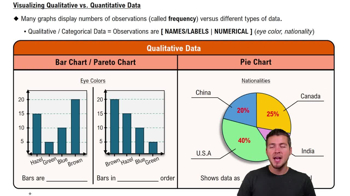
Data organization refers to the systematic arrangement of data to facilitate analysis and interpretation. In statistics, organizing data into graphs or tables helps to summarize information, making it easier to identify trends, patterns, and outliers. Proper organization is crucial for effective data visualization, which aids in drawing meaningful conclusions from the data set.
Recommended video:
Guided course
Visualizing Qualitative vs. Quantitative Data
Describing Patterns
Describing patterns in data involves analyzing the visual representation to identify trends, clusters, or anomalies. This can include noting the distribution of values, such as whether they are concentrated in a particular range or if there are any noticeable gaps. Recognizing these patterns is essential for making informed interpretations and decisions based on the data presented.
Recommended video:
Guided course
Find 5-Number Summary - TI-84 Calculator Example 1
Related Videos
Related Practice
Multiple Choice
413
views
10
rank
