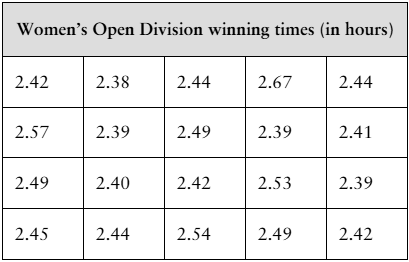
[APPLET] The winning times (in hours) for a sample of 20 randomly selected Boston Marathon Women’s Open Division champions from 1980 to 2019 are shown in the table at the left. Assume the population standard deviation is 0.068 hour. (Source: Boston Athletic Association) a. Find the point estimate of the population mean.
Verified step by step guidance
1
Step 1: Understand the problem. The goal is to find the point estimate of the population mean, which is the sample mean. The sample mean is calculated by summing all the data points and dividing by the total number of data points.
Step 2: Identify the data provided. The table contains 20 winning times (in hours) for the Boston Marathon Women’s Open Division champions. These values are the sample data.
Step 3: Write the formula for the sample mean. The formula is: , where is the sample mean, is the number of data points, and are the individual data points.
Step 4: Add all the values in the table. Carefully sum each of the 20 winning times provided in the table. This will give the total sum of the data points.
Step 5: Divide the total sum by the number of data points (20). This will yield the sample mean, which is the point estimate of the population mean.
Verified video answer for a similar problem:
This video solution was recommended by our tutors as helpful for the problem above
Video duration:
1m
Play a video:
0 Comments
Key Concepts
Here are the essential concepts you must grasp in order to answer the question correctly.
Point Estimate
A point estimate is a single value used to estimate a population parameter. In this context, the point estimate of the population mean is calculated by taking the average of the winning times of the sampled Boston Marathon champions. It provides a quick summary of the data and serves as a best guess for the true population mean.
The population mean is the average of all values in a population, representing a central tendency. It is a key parameter in statistics, often denoted by the symbol μ. In this case, the population mean would reflect the average winning time of all Boston Marathon Women’s Open Division champions from 1980 to 2019, which we aim to estimate using the sample data.
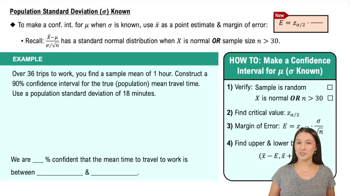
Standard deviation is a measure of the amount of variation or dispersion in a set of values. It indicates how much individual data points differ from the mean. In this question, the population standard deviation is given as 0.068 hours, which helps assess the reliability of the point estimate and the spread of winning times among the sampled champions.