Contacting Parents A research organization conducts a survey by randomly selecting adults and asking each, “How frequently do you contact your parents by phone?” The results are shown in the figure. (Adapted from Pew Research Center) a. Use a sign test to test the null hypothesis that the proportion of adults who contact their parents by phone weekly is equal to the proportion of adults who contact their parents by phone daily. Assign a + sign to each adult who responded “weekly,” assign a - sign to each adult who responded “daily,” and assign a 0 to each adult who responded “other.” Use α = 0.05
Verified step by step guidance
1
Step 1: Understand the sign test. The sign test is a non-parametric test used to compare two related samples or proportions. Here, we are testing the null hypothesis that the proportion of adults who contact their parents weekly is equal to the proportion of adults who contact their parents daily.
Step 2: Assign signs to the data. Based on the problem, assign a '+' sign to each adult who responded 'weekly,' a '-' sign to each adult who responded 'daily,' and a '0' to each adult who responded 'other.' From the pie chart, we have 12 adults for 'weekly,' 8 adults for 'daily,' and 6 adults for 'other.'
Step 3: Exclude the '0' responses. Since the 'other' responses are assigned a '0,' they are excluded from the analysis. This leaves us with 12 '+' signs and 8 '-' signs.
Step 4: Calculate the test statistic. Count the number of '+' signs and '-' signs. The smaller of these two counts will be used as the test statistic. In this case, the smaller count is 8 (number of '-' signs).
Step 5: Compare the test statistic to the critical value. Using the sign test table for α = 0.05 and the total number of non-zero responses (12 + 8 = 20), find the critical value. If the test statistic is less than or equal to the critical value, reject the null hypothesis; otherwise, fail to reject the null hypothesis.
Verified video answer for a similar problem:
This video solution was recommended by our tutors as helpful for the problem above
Video duration:
6m
Play a video:
0 Comments
Key Concepts
Here are the essential concepts you must grasp in order to answer the question correctly.
Sign Test
The sign test is a non-parametric statistical method used to evaluate the median of a distribution. It is particularly useful when comparing two related samples or matched observations. In this context, it helps determine if there is a significant difference between the proportions of adults contacting their parents weekly versus daily by assigning positive, negative, or neutral signs to their responses.
The null hypothesis is a statement that assumes no effect or no difference between groups in a statistical test. In this scenario, the null hypothesis posits that the proportion of adults who contact their parents weekly is equal to the proportion who contact them daily. Testing this hypothesis allows researchers to determine if observed differences in survey responses are statistically significant.
The significance level, denoted as α, is the threshold for determining whether to reject the null hypothesis. Commonly set at 0.05, it indicates a 5% risk of concluding that a difference exists when there is none. In this case, if the p-value from the sign test is less than 0.05, it suggests that the difference in contact frequency is statistically significant.

 6:32 minutes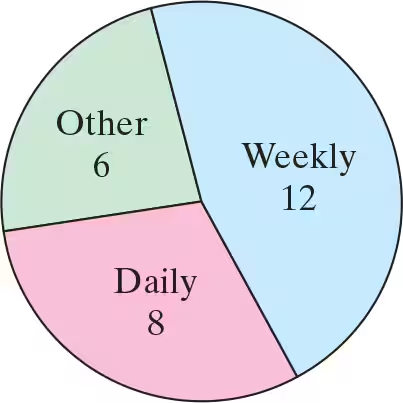
 Verified step by step guidance
 06:28
06:28