Identifying Hypotheses Refer to the data given in Exercise 1 and assume that the requirements are all satisfied and we want to conduct a hypothesis test of independence using the methods of this section. Identify the null and alternative hypotheses.
Table of contents
- 1. Intro to Stats and Collecting Data1h 14m
- 2. Describing Data with Tables and Graphs1h 56m
- 3. Describing Data Numerically2h 5m
- 4. Probability2h 17m
- 5. Binomial Distribution & Discrete Random Variables3h 6m
- 6. Normal Distribution and Continuous Random Variables2h 11m
- 7. Sampling Distributions & Confidence Intervals: Mean3h 23m
- Sampling Distribution of the Sample Mean and Central Limit Theorem19m
- Distribution of Sample Mean - ExcelBonus23m
- Introduction to Confidence Intervals15m
- Confidence Intervals for Population Mean1h 18m
- Determining the Minimum Sample Size Required12m
- Finding Probabilities and T Critical Values - ExcelBonus28m
- Confidence Intervals for Population Means - ExcelBonus25m
- 8. Sampling Distributions & Confidence Intervals: Proportion2h 10m
- 9. Hypothesis Testing for One Sample5h 8m
- Steps in Hypothesis Testing1h 6m
- Performing Hypothesis Tests: Means1h 4m
- Hypothesis Testing: Means - ExcelBonus42m
- Performing Hypothesis Tests: Proportions37m
- Hypothesis Testing: Proportions - ExcelBonus27m
- Performing Hypothesis Tests: Variance12m
- Critical Values and Rejection Regions28m
- Link Between Confidence Intervals and Hypothesis Testing12m
- Type I & Type II Errors16m
- 10. Hypothesis Testing for Two Samples5h 37m
- Two Proportions1h 13m
- Two Proportions Hypothesis Test - ExcelBonus28m
- Two Means - Unknown, Unequal Variance1h 3m
- Two Means - Unknown Variances Hypothesis Test - ExcelBonus12m
- Two Means - Unknown, Equal Variance15m
- Two Means - Unknown, Equal Variances Hypothesis Test - ExcelBonus9m
- Two Means - Known Variance12m
- Two Means - Sigma Known Hypothesis Test - ExcelBonus21m
- Two Means - Matched Pairs (Dependent Samples)42m
- Matched Pairs Hypothesis Test - ExcelBonus12m
- Two Variances and F Distribution29m
- Two Variances - Graphing CalculatorBonus16m
- 11. Correlation1h 24m
- 12. Regression3h 33m
- Linear Regression & Least Squares Method26m
- Residuals12m
- Coefficient of Determination12m
- Regression Line Equation and Coefficient of Determination - ExcelBonus8m
- Finding Residuals and Creating Residual Plots - ExcelBonus11m
- Inferences for Slope31m
- Enabling Data Analysis ToolpakBonus1m
- Regression Readout of the Data Analysis Toolpak - ExcelBonus21m
- Prediction Intervals13m
- Prediction Intervals - ExcelBonus19m
- Multiple Regression - ExcelBonus29m
- Quadratic Regression15m
- Quadratic Regression - ExcelBonus10m
- 13. Chi-Square Tests & Goodness of Fit2h 21m
- 14. ANOVA2h 29m
13. Chi-Square Tests & Goodness of Fit
Independence Tests
Problem 11.q.8
Textbook Question
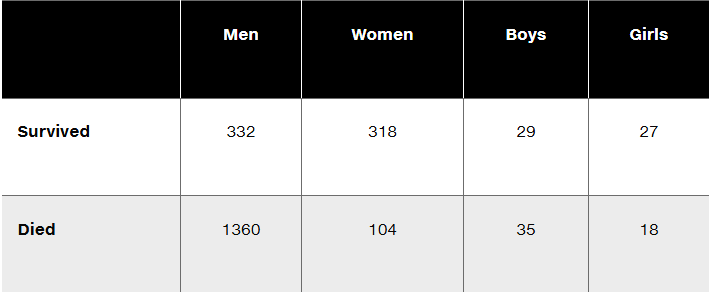
Questions 6–10 refer to the sample data in the following table, which describes the fate of the passengers and crew aboard the Titanic when it sank on April 15, 1912. Assume that the data are a sample from a large population and we want to use a 0.05 significance level to test the claim that surviving is independent of whether the person is a man, woman, boy, or girl.

Is the hypothesis test left-tailed, right-tailed, or two-tailed?
Verified step by step guidance1
Step 1: Understand the hypothesis test. The claim is that surviving is independent of whether the person is a man, woman, boy, or girl. This means we are testing for independence between two categorical variables: survival status (survived or died) and gender/age group (men, women, boys, girls).
Step 2: Determine the type of test. Since we are testing for independence between two categorical variables, a Chi-Square Test for Independence is appropriate.
Step 3: Identify the significance level. The problem specifies a significance level of 0.05, which will be used to compare the p-value obtained from the test.
Step 4: Decide the tail of the test. A Chi-Square Test for Independence is inherently a two-tailed test because it evaluates whether there is any association (positive or negative) between the variables, not just one direction.
Step 5: Prepare the contingency table. The table provided in the image already serves as the contingency table, showing the observed frequencies for each combination of survival status and gender/age group. These values will be used to calculate the expected frequencies and the Chi-Square statistic.
Verified video answer for a similar problem:This video solution was recommended by our tutors as helpful for the problem above
Video duration:
4mPlay a video:
0 Comments
Key Concepts
Here are the essential concepts you must grasp in order to answer the question correctly.
Hypothesis Testing
Hypothesis testing is a statistical method used to make decisions about a population based on sample data. It involves formulating a null hypothesis (H0) and an alternative hypothesis (H1), then using sample data to determine whether to reject H0. In this context, the null hypothesis would state that survival is independent of gender, while the alternative would suggest a dependence.
Recommended video:
Guided course
Step 1: Write Hypotheses
Significance Level
The significance level, denoted as alpha (α), is the threshold for determining whether to reject the null hypothesis. A common significance level is 0.05, which indicates a 5% risk of concluding that a difference exists when there is none. In this case, it means that if the p-value is less than 0.05, we would reject the null hypothesis regarding survival independence.
Recommended video:
Guided course
Step 4: State Conclusion Example 4
Types of Hypothesis Tests
Hypothesis tests can be classified as left-tailed, right-tailed, or two-tailed based on the nature of the alternative hypothesis. A left-tailed test checks for a decrease in a parameter, a right-tailed test checks for an increase, and a two-tailed test checks for any difference. In this scenario, since we are testing for independence without a specific direction, it would typically be a two-tailed test.
Recommended video:
Guided course
Step 1: Write Hypotheses
Related Videos
Related Practice