Ch. 5 - Discrete Probability Distributions
Triola - Elementary Statistics 14th Edition
Triola14th EditionElementary StatisticsISBN: 9780137366446Not the one you use?Change textbook
Chapter 5, Problem 6b

 In Exercises 5–8, assume that the Poisson distribution applies; assume that the mean number of Atlantic hurricanes in the United States is 5.5 per year, as in Example 1; and proceed to find the indicated probability.


Hurricanes


b. In a 118-year period, how many years are expected to have no hurricanes?

Verified step by step guidance
1
Step 1: Understand the problem. The Poisson distribution is used to model the number of events (hurricanes) occurring in a fixed interval of time (years). The mean number of hurricanes per year is given as λ = 5.5. We are tasked with finding the expected number of years with no hurricanes over a 118-year period.
Step 2: Recall the formula for the Poisson probability mass function (PMF): P(X = k) = (λ^k * e^(-λ)) / k!, where X is the number of events, λ is the mean number of events, k is the specific number of events (in this case, k = 0 for no hurricanes), and e is the base of the natural logarithm.
Step 3: Calculate the probability of having no hurricanes in a single year using the Poisson PMF. Substitute λ = 5.5 and k = 0 into the formula: P(X = 0) = (5.5^0 * e^(-5.5)) / 0!. Simplify the expression, noting that 0! = 1 and 5.5^0 = 1.
Step 4: Once the probability of no hurricanes in a single year is determined, multiply this probability by the total number of years (118) to find the expected number of years with no hurricanes. Use the formula: Expected years = P(X = 0) * 118.
Step 5: Interpret the result. The final value represents the expected number of years out of 118 that will have no hurricanes, based on the given mean of 5.5 hurricanes per year.

Verified video answer for a similar problem:

This video solution was recommended by our tutors as helpful for the problem above.
Video duration:
2m
Was this helpful?

Key Concepts

Here are the essential concepts you must grasp in order to answer the question correctly.

Poisson Distribution

The Poisson distribution is a probability distribution that expresses the probability of a given number of events occurring in a fixed interval of time or space, given a known average rate of occurrence. It is particularly useful for modeling rare events, such as natural disasters, where the events are independent of each other.
Recommended video:
Guided course
06:38
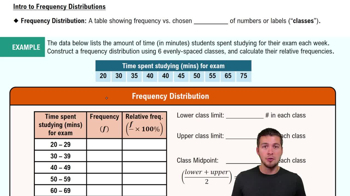
Intro to Frequency Distributions

Expected Value

The expected value is a key concept in probability that represents the average outcome of a random variable over a large number of trials. In the context of the Poisson distribution, the expected number of occurrences can be calculated by multiplying the average rate (mean) by the number of intervals considered.
Recommended video:
Guided course
04:14
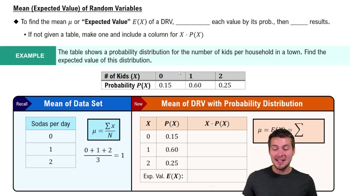
Expected Value (Mean) of Random Variables

Probability of No Events

In a Poisson distribution, the probability of observing zero events in a given interval can be calculated using the formula P(X=0) = e^(-λ), where λ is the mean number of events. This concept is crucial for determining how many years in a specified period are expected to have no hurricanes, based on the average rate.
Recommended video:
05:54
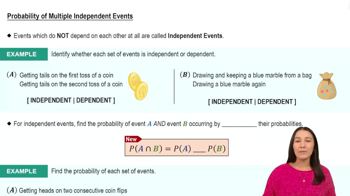
Probability of Multiple Independent Events
Related Practice
Textbook Question

In Exercises 6–10, refer to the accompanying table, which describes the numbers of adults in groups of five who reported sleepwalking (based on data from “Prevalence and Comorbidity of Nocturnal Wandering In the U.S. Adult General Population,” by Ohayon et al., Neurology, Vol. 78, No. 20).


Probability Find the probability that at least one of the subjects is a sleepwalker.

158
views
Textbook Question

Texting and Driving. In Exercises 21–26, refer to the accompanying table, which describes probabilities for groups of five drivers. The random variable x is the number of drivers in a group who say that they text while driving (based on data from an Arity survey of drivers).

For groups of five drivers, find the mean and standard deviation for the numbers of drivers who say that they text while driving.

82
views
Textbook Question

 In Exercises 5–8, assume that the Poisson distribution applies; assume that the mean number of Atlantic hurricanes in the United States is 5.5 per year, as in Example 1; and proceed to find the indicated probability.


Hurricanes


a. Find the probability that in a year, there will be no hurricanes.

141
views
Textbook Question

Texting and Driving. In Exercises 21–26, refer to the accompanying table, which describes probabilities for groups of five drivers. The random variable x is the number of drivers in a group who say that they text while driving (based on data from an Arity survey of drivers).

Using Probabilities for Significant Events


b. Find the probability of getting 3 or more drivers who say that they text while driving.

117
views
Textbook Question

Texting and Driving. In Exercises 21–26, refer to the accompanying table, which describes probabilities for groups of five drivers. The random variable x is the number of drivers in a group who say that they text while driving (based on data from an Arity survey of drivers).

Range Rule of Thumb for Significant Events

Use the range rule of thumb to determine whether 1 is a significantly low number of drivers who say that they text while driving.

107
views
Textbook Question

In Exercises 6–10, refer to the accompanying table, which describes the numbers of adults in groups of five who reported sleepwalking (based on data from “Prevalence and Comorbidity of Nocturnal Wandering In the U.S. Adult General Population,” by Ohayon et al., Neurology, Vol. 78, No. 20).


Does the table describe a probability distribution?

187
views