
Ch. 5 - Discrete Probability Distributions
Triola - Elementary Statistics 14th Edition
Triola14th EditionElementary StatisticsISBN: 9780137366446Not the one you use?Change textbook
Chapter 5, Problem 21

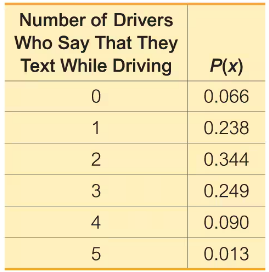
Texting and Driving. In Exercises 21–26, refer to the accompanying table, which describes probabilities for groups of five drivers. The random variable x is the number of drivers in a group who say that they text while driving (based on data from an Arity survey of drivers).

For groups of five drivers, find the mean and standard deviation for the numbers of drivers who say that they text while driving.

Verified step by step guidance
1
Step 1: Understand the problem. We are tasked with finding the mean (expected value) and standard deviation for the number of drivers who say they text while driving. The table provides the probability distribution for the random variable x, which represents the number of drivers in a group of five who text while driving.
Step 2: Calculate the mean (expected value). The formula for the mean of a discrete random variable is: μ=xxP(x). Multiply each value of x by its corresponding probability P(x), then sum these products.
Step 3: Calculate the variance. The formula for variance is: σ²=x(xμ)²P(x). First, subtract the mean μ from each value of x, square the result, multiply by the corresponding probability P(x), and sum these values.
Step 4: Calculate the standard deviation. The standard deviation is the square root of the variance: σ=σ². Take the square root of the variance calculated in Step 3.
Step 5: Interpret the results. The mean represents the average number of drivers in a group of five who text while driving, and the standard deviation measures the variability of this number around the mean.

Verified video answer for a similar problem:

This video solution was recommended by our tutors as helpful for the problem above.
Video duration:
4m
Was this helpful?

Key Concepts

Here are the essential concepts you must grasp in order to answer the question correctly.

Random Variable

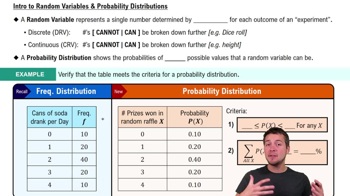
A random variable is a numerical outcome of a random phenomenon. In this context, the random variable x represents the number of drivers in a group of five who report texting while driving. Understanding random variables is crucial for analyzing probabilities and calculating statistical measures such as the mean and standard deviation.
Recommended video:
Guided course
07:09
Intro to Random Variables & Probability Distributions

Mean of a Probability Distribution

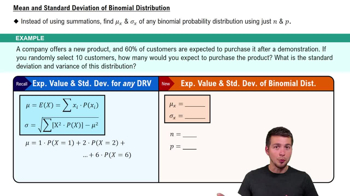
The mean of a probability distribution, also known as the expected value, is calculated by multiplying each possible value of the random variable by its corresponding probability and summing these products. This measure provides a central value that represents the average outcome of the random variable, which is essential for interpreting the data on drivers texting while driving.
Recommended video:
Guided course
03:28
Mean & Standard Deviation of Binomial Distribution

Standard Deviation

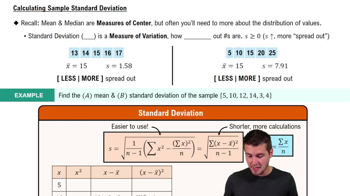
Standard deviation is a measure of the amount of variation or dispersion in a set of values. In the context of a probability distribution, it quantifies how much the values of the random variable deviate from the mean. A low standard deviation indicates that the values tend to be close to the mean, while a high standard deviation suggests a wider spread of values, which is important for understanding the variability in drivers' behaviors.
Recommended video:
Guided course
08:45
Calculating Standard Deviation
Related Practice
Textbook Question

 In Exercises 5–8, assume that the Poisson distribution applies; assume that the mean number of Atlantic hurricanes in the United States is 5.5 per year, as in Example 1; and proceed to find the indicated probability.


Hurricanes


b. In a 118-year period, how many years are expected to have no hurricanes?

130
views
Textbook Question

 In Exercises 5–8, assume that the Poisson distribution applies; assume that the mean number of Atlantic hurricanes in the United States is 5.5 per year, as in Example 1; and proceed to find the indicated probability.


Hurricanes


a. Find the probability that in a year, there will be no hurricanes.

141
views
Textbook Question

Texting and Driving. In Exercises 21–26, refer to the accompanying table, which describes probabilities for groups of five drivers. The random variable x is the number of drivers in a group who say that they text while driving (based on data from an Arity survey of drivers).

Using Probabilities for Significant Events


b. Find the probability of getting 3 or more drivers who say that they text while driving.

117
views
Textbook Question

Texting and Driving. In Exercises 21–26, refer to the accompanying table, which describes probabilities for groups of five drivers. The random variable x is the number of drivers in a group who say that they text while driving (based on data from an Arity survey of drivers).

Using Probabilities for Significant Events

d. Is 3 a significantly high number of drivers who say that they text while driving? Why or why not?

89
views
Textbook Question

Texting and Driving. In Exercises 21–26, refer to the accompanying table, which describes probabilities for groups of five drivers. The random variable x is the number of drivers in a group who say that they text while driving (based on data from an Arity survey of drivers).

Range Rule of Thumb for Significant Events

Use the range rule of thumb to determine whether 1 is a significantly low number of drivers who say that they text while driving.

107
views
Textbook Question

In Exercises 6–10, refer to the accompanying table, which describes the numbers of adults in groups of five who reported sleepwalking (based on data from “Prevalence and Comorbidity of Nocturnal Wandering In the U.S. Adult General Population,” by Ohayon et al., Neurology, Vol. 78, No. 20).


Does the table describe a probability distribution?

187
views