In Exercises 27–32, select the representations that do not change the location of the given point. (−2, 7π/6) (−2, −5π/6)
Verified step by step guidance
1
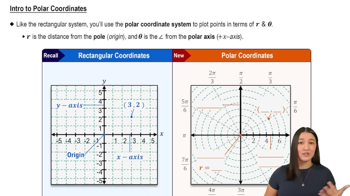
Understand that a point in polar coordinates is given as \((r, \theta)\), where \(r\) is the radius (distance from the origin) and \(\theta\) is the angle measured from the positive x-axis.
Recall that changing the angle by adding or subtracting multiples of \(2\pi\) (full rotations) does not change the location of the point because angles are periodic with period \(2\pi\).
Note that changing the radius \(r\) to its negative value \(-r\) and adding \(\pi\) to the angle \(\theta\) also represents the same point, because moving in the opposite direction by \(\pi\) radians lands you at the same location.
For the point \((-2, \frac{7\pi}{6})\), check if representations like \((2, \frac{7\pi}{6} + \pi)\) or \((r, \theta + 2k\pi)\) (where \(k\) is an integer) keep the point unchanged.
Similarly, for the point \((-2, -\frac{5\pi}{6})\), apply the same rules: adding multiples of \(2\pi\) to the angle or changing \(r\) to \(-r\) and adding \(\pi\) to the angle to find equivalent representations.
Verified video answer for a similar problem:
This video solution was recommended by our tutors as helpful for the problem above
Play a video:
0 Comments
Key Concepts
Here are the essential concepts you must grasp in order to answer the question correctly.
Polar Coordinates and Point Representation
Polar coordinates represent points using a radius and an angle (r, θ). The radius indicates the distance from the origin, and the angle specifies the direction from the positive x-axis. Understanding how points are plotted in this system is essential to analyze transformations that affect their location.
A single point in polar coordinates can have multiple representations due to angle periodicity and sign changes in radius. For example, adding or subtracting 2π to the angle or negating the radius while adjusting the angle by π results in the same point. Recognizing these equivalences helps identify which transformations preserve the point's location.
Effect of Angle and Radius Transformations on Point Location
Changing the angle by multiples of 2π or adjusting the radius and angle simultaneously can alter or preserve a point's position. Understanding how these transformations affect the coordinates allows one to determine which representations maintain the original point's location and which do not.

 Verified step by step guidance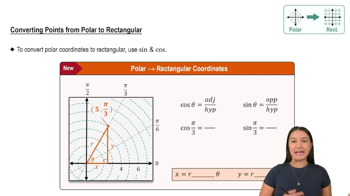
 06:17
06:17