In Exercises 29–44, graph two periods of the given cosecant or secant function. y = 2 sec(x + π)
Verified step by step guidance
1
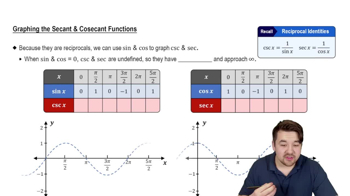
Identify the given function: \(y = 2 \sec(x + \pi)\). Recall that the secant function is the reciprocal of the cosine function, so \(\sec \theta = \frac{1}{\cos \theta}\).
Determine the period of the basic secant function. Since \(\sec x\) has the same period as \(\cos x\), which is \(2\pi\), the period of \(y = 2 \sec(x + \pi)\) remains \(2\pi\) because the horizontal shift does not affect the period.
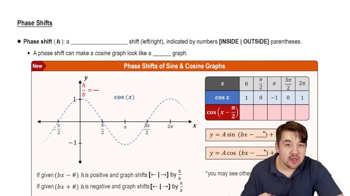
Find the horizontal shift caused by the term \((x + \pi)\). This represents a shift to the left by \(\pi\) units. So, the graph of \(\sec x\) is shifted left by \(\pi\).
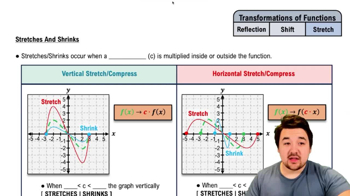
Calculate the amplitude and vertical stretch. The coefficient 2 in front of \(\sec\) stretches the graph vertically by a factor of 2. Note that secant functions do not have a maximum or minimum amplitude, but this factor affects the distance from the midline.
To graph two periods, plot the function from \(x = -\pi\) (starting point due to shift) to \(x = -\pi + 4\pi = 3\pi\). Mark key points where \(\cos(x + \pi) = 0\) (vertical asymptotes for \(\sec\)), and plot the corresponding \(y\) values using \(y = 2 \sec(x + \pi)\) between these asymptotes.
Verified video answer for a similar problem:
This video solution was recommended by our tutors as helpful for the problem above
Video duration:
7m
Play a video:
0 Comments
Key Concepts
Here are the essential concepts you must grasp in order to answer the question correctly.
Secant Function and Its Properties
The secant function, sec(x), is the reciprocal of the cosine function, defined as sec(x) = 1/cos(x). It has vertical asymptotes where cos(x) = 0, and its graph consists of branches extending to infinity. Understanding its periodicity and behavior near asymptotes is essential for accurate graphing.
A phase shift occurs when the input variable x is replaced by (x + c), shifting the graph horizontally. For y = 2 sec(x + π), the graph of sec(x) shifts left by π units. Recognizing this shift helps in correctly positioning the function's key features like peaks, troughs, and asymptotes.
The coefficient 2 in y = 2 sec(x + π) vertically stretches the secant graph by a factor of 2. This affects the distance of the graph's branches from the x-axis, making them twice as far compared to the basic sec(x) graph. Understanding vertical stretch is crucial for accurate graph scaling.

 7:11 minutes
 Verified step by step guidance
 6:22
6:22