Use a calculator to approximate each real number value. (Be sure the calculator is in radian mode.) y = cot⁻¹ (―0.92170128)
Verified step by step guidance
1
Recognize that the problem asks for the inverse cotangent (cot⁻¹) of a given value, which means finding the angle y such that \( \cot(y) = -0.92170128 \).
Recall the relationship between cotangent and tangent: \( \cot(y) = \frac{1}{\tan(y)} \). This can help if your calculator does not have a direct cotangent inverse function.
Rewrite the equation using tangent: \( y = \cot^{-1}(-0.92170128) = \tan^{-1}\left(\frac{1}{-0.92170128}\right) \).
Calculate the value inside the inverse tangent function: \( \frac{1}{-0.92170128} \), then use your calculator (in radian mode) to find \( \tan^{-1} \) of that result.
Interpret the calculator output carefully, considering the range of the inverse cotangent function, which is usually \( (0, \pi) \) for real values, and adjust the angle if necessary to ensure it lies within this principal range.
Verified video answer for a similar problem:
This video solution was recommended by our tutors as helpful for the problem above
Play a video:
0 Comments
Key Concepts
Here are the essential concepts you must grasp in order to answer the question correctly.
Inverse Cotangent Function (cot⁻¹ or arccot)
The inverse cotangent function returns the angle whose cotangent is a given number. It is the inverse of the cotangent function, which is the ratio of the adjacent side to the opposite side in a right triangle. Understanding its range and behavior is essential for correctly interpreting the output angle.
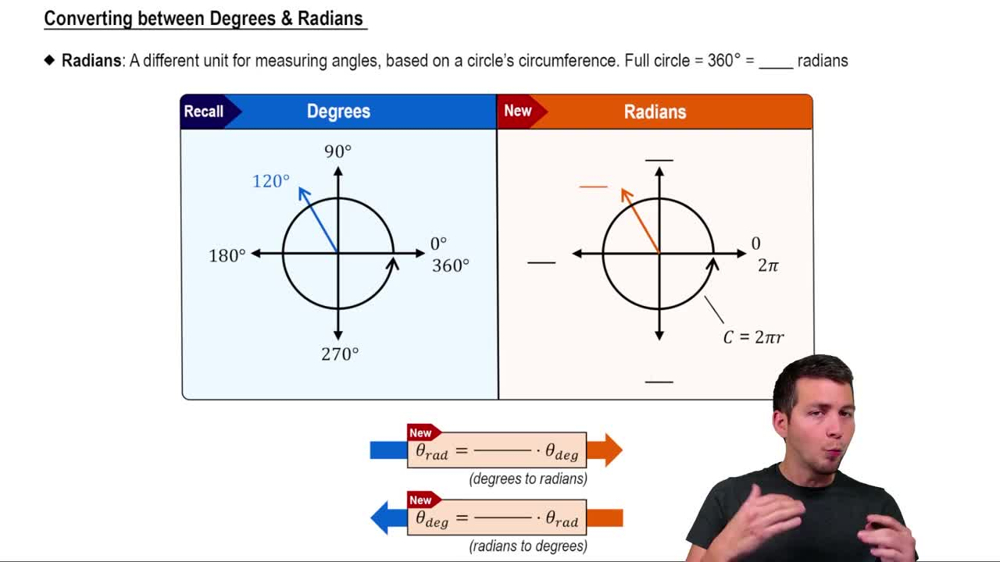
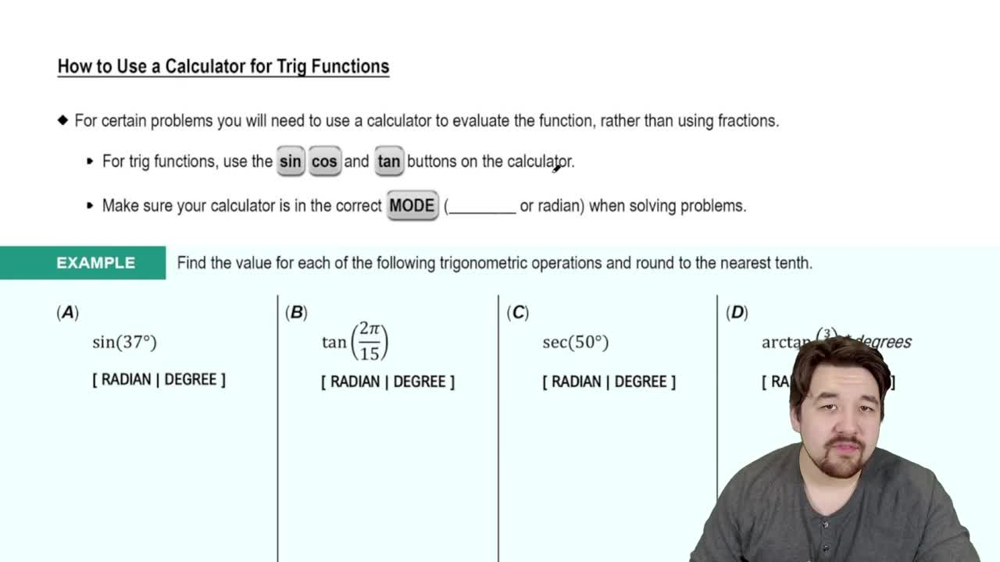
Radian mode means the calculator interprets angles in radians rather than degrees. Since many trigonometric functions and their inverses are naturally defined in radians, ensuring the calculator is in radian mode is crucial for accurate results, especially in calculus and higher mathematics.
Using a Calculator to Approximate Trigonometric Values
Calculators can approximate inverse trigonometric values by inputting the given number and selecting the correct inverse function. Knowing how to enter values, switch modes, and interpret the output helps in obtaining precise numerical approximations for angles.

 Verified step by step guidance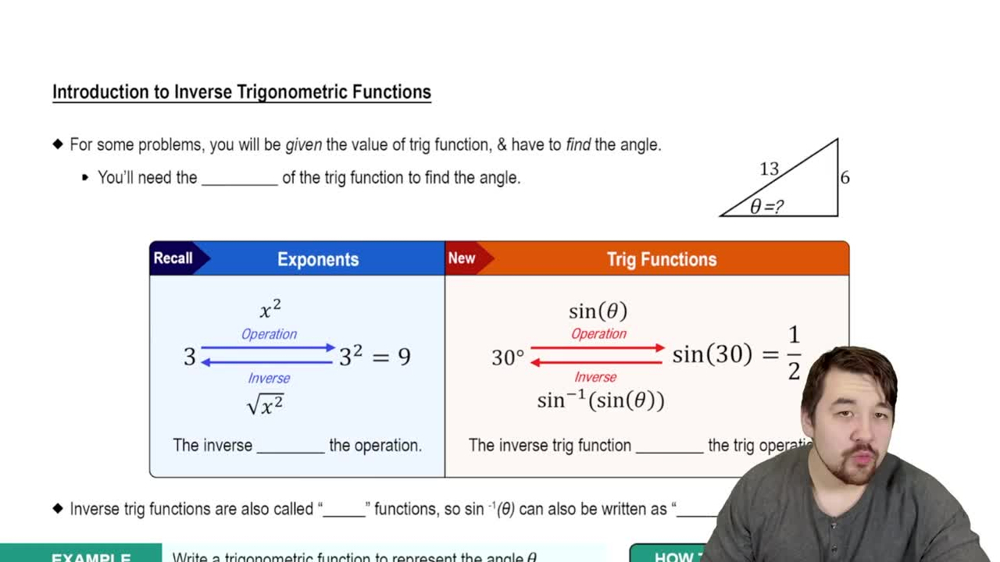
 4:28
4:28