Use a calculator to approximate each real number value. (Be sure the calculator is in radian mode.) y = arctan 1.1111111
Verified step by step guidance
1
Understand that the function \( y = \arctan(x) \) gives the angle \( y \) whose tangent is \( x \). In this problem, \( y = \arctan(1.1111111) \) means we want the angle whose tangent is approximately 1.1111111.
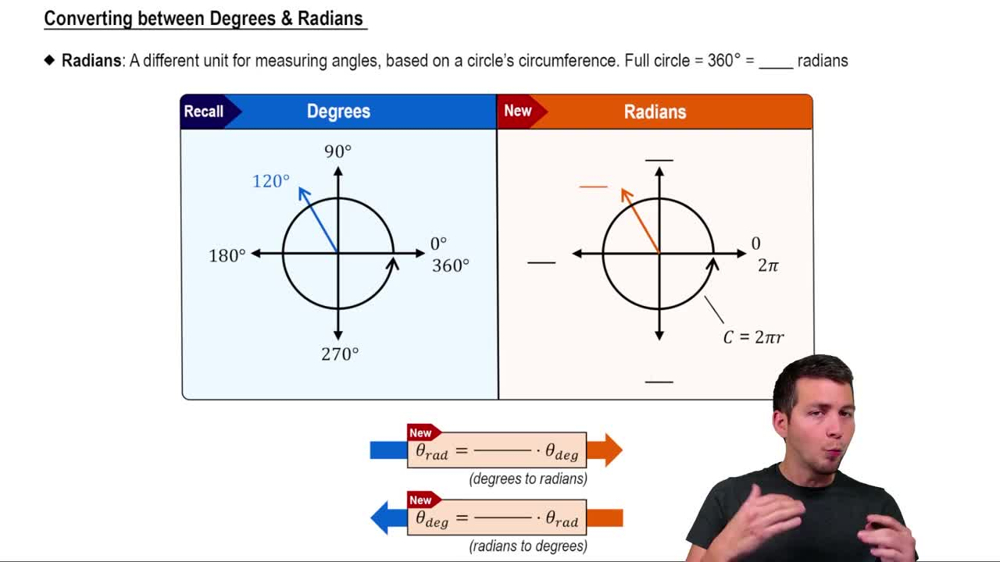
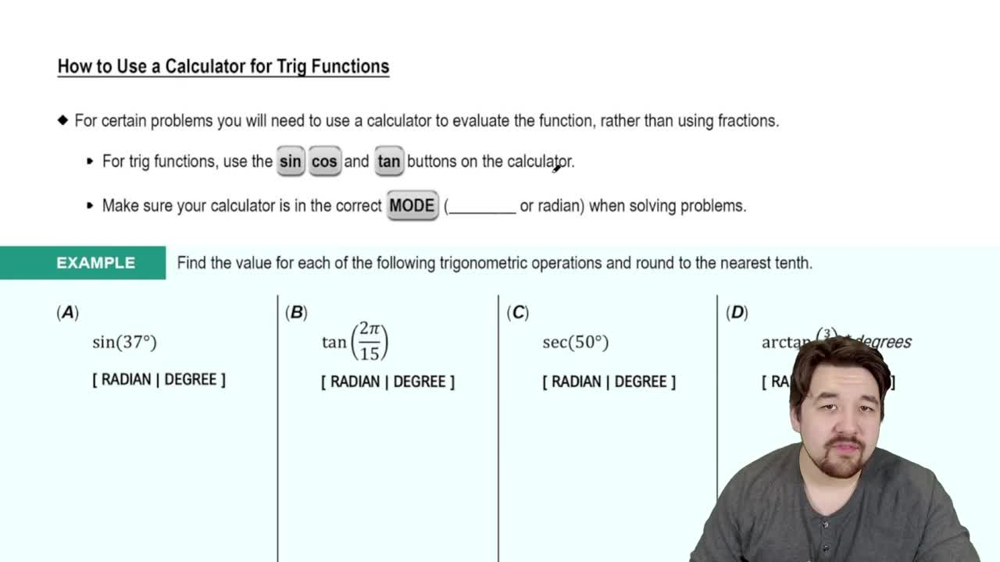
Make sure your calculator is set to radian mode because the problem specifies that the answer should be in radians. This is important because inverse trigonometric functions can give results in degrees or radians depending on the mode.
Enter the value 1.1111111 into your calculator and then press the \( \arctan \) or \( \tan^{-1} \) function key. This will compute the angle \( y \) in radians.
The calculator will display the approximate value of \( y \), which is the angle in radians whose tangent is 1.1111111.
Interpret the result as the solution to the problem: \( y = \arctan(1.1111111) \) in radians.
Verified video answer for a similar problem:
This video solution was recommended by our tutors as helpful for the problem above
Play a video:
0 Comments
Key Concepts
Here are the essential concepts you must grasp in order to answer the question correctly.
Inverse Trigonometric Functions
Inverse trigonometric functions, like arctan, reverse the process of trigonometric functions, returning the angle whose tangent is a given number. For arctan(x), the output is the angle θ such that tan(θ) = x, typically within the range (-π/2, π/2).
Calculators can operate in degree or radian mode, affecting the interpretation of angle measures. Since trigonometric functions can use either, ensuring the calculator is in radian mode is essential when the problem specifies radians, to get correct angle values in radians.
To approximate values like y = arctan(1.1111111), input the number into the calculator's inverse tangent function. The calculator then provides a decimal approximation of the angle in radians, which is useful when exact values are not easily expressed in simple fractions or multiples of π.

 Verified step by step guidance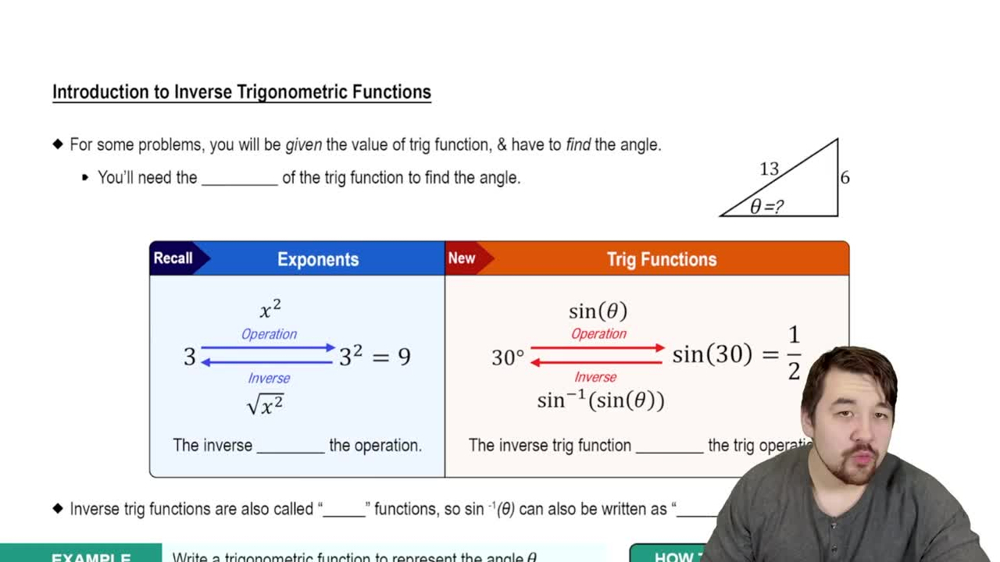
 4:28
4:28