In Exercises 59–62, use a calculator to find the value of the acute angle θ in radians, rounded to three decimal places. cos θ = 0.4112
Verified step by step guidance
1
Identify that the problem requires finding the acute angle \( \theta \) such that \( \cos \theta = 0.4112 \). Since \( \theta \) is acute, it lies between 0 and \( \frac{\pi}{2} \) radians.
Recall that to find \( \theta \) from \( \cos \theta = x \), you use the inverse cosine function: \( \theta = \cos^{-1}(x) \).
Set up the equation: \( \theta = \cos^{-1}(0.4112) \).
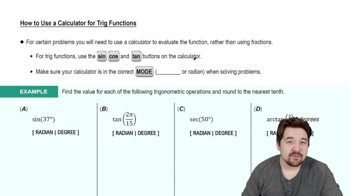
Use a calculator in radian mode to evaluate \( \cos^{-1}(0.4112) \). Make sure your calculator is set to radians, not degrees.
Round the result to three decimal places to get the value of the acute angle \( \theta \) in radians.
Verified video answer for a similar problem:
This video solution was recommended by our tutors as helpful for the problem above
Video duration:
2m
Play a video:
0 Comments
Key Concepts
Here are the essential concepts you must grasp in order to answer the question correctly.
Inverse Cosine Function (arccos)
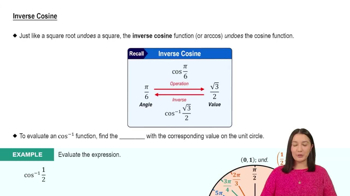
The inverse cosine function, denoted as arccos or cos⁻¹, is used to find the angle whose cosine value is given. It returns an angle in the range 0 to π radians (0° to 180°), which is essential for determining θ when cos θ is known.
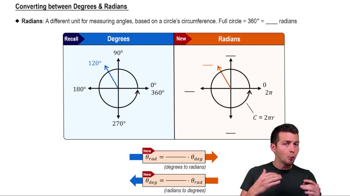
Radians are a way to measure angles based on the radius of a circle, where 2π radians equal 360 degrees. Understanding radians is crucial for interpreting and expressing the angle θ in the required unit, especially when using calculators set to radian mode.
Calculators can compute inverse trigonometric functions to find angles from given ratios. It is important to ensure the calculator is set to radian mode and to round the result correctly, here to three decimal places, to meet the problem’s requirements.