Fill in the blank(s) to correctly complete each sentence. The graph of y = cos (x - π/6) is obtained by shifting the graph of y = cos x ______ unit(s) to the ________ (right/left).
Verified step by step guidance
1
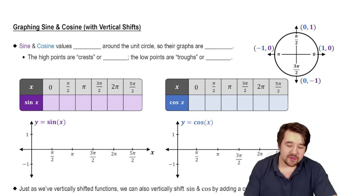
Recall that the function y = cos(x - c) represents a horizontal shift of the basic cosine graph y = cos x by c units.
If the function is y = cos(x - \(\frac{\pi}{6}\)), the graph is shifted horizontally by \(\frac{\pi}{6}\) units.
Since the expression inside the cosine is (x - \(\frac{\pi}{6}\)), this corresponds to a shift to the right by \(\frac{\pi}{6}\) units.
Therefore, the graph of y = cos(x - \(\frac{\pi}{6}\)) is obtained by shifting the graph of y = cos x \(\frac{\pi}{6}\) unit(s) to the right.
Fill in the blanks with: "\(\frac{\pi}{6}\)" and "right".
Verified video answer for a similar problem:
This video solution was recommended by our tutors as helpful for the problem above
Play a video:
0 Comments
Key Concepts
Here are the essential concepts you must grasp in order to answer the question correctly.
Horizontal Phase Shift in Trigonometric Functions
A horizontal phase shift occurs when the input variable x in a trigonometric function is replaced by (x - c), shifting the graph horizontally. If the function is y = cos(x - c), the graph shifts c units to the right; if y = cos(x + c), it shifts c units to the left.
The argument inside the cosine function, such as (x - π/6), determines the horizontal position of the wave. Modifying this argument translates the graph along the x-axis without changing its shape or amplitude.
Graphical Interpretation of Trigonometric Transformations
Graph transformations help visualize how changes in the function's formula affect its graph. Recognizing shifts, stretches, and reflections allows one to predict and sketch the new graph accurately.

 Verified step by step guidance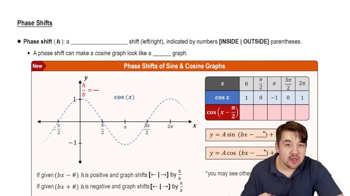
 6:31
6:31