Convert x² + (y + 8)² = 64 to a polar equation that expresses r in terms of θ.
Verified step by step guidance
1
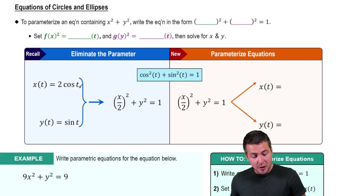
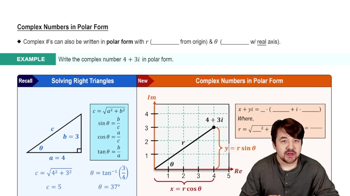
Recall the relationships between Cartesian coordinates and polar coordinates: \(x = r \cos\theta\) and \(y = r \sin\theta\).
Substitute \(x = r \cos\theta\) and \(y = r \sin\theta\) into the given equation \(x^2 + (y + 8)^2 = 64\) to rewrite it in terms of \(r\) and \(\theta\).
Expand the expression: \(x^2\) becomes \((r \cos\theta)^2 = r^2 \cos^2\theta\), and \((y + 8)^2\) becomes \((r \sin\theta + 8)^2\).
Write the equation as \(r^2 \cos^2\theta + (r \sin\theta + 8)^2 = 64\) and expand the squared term to get \(r^2 \sin^2\theta + 16r \sin\theta + 64\).
Combine like terms and simplify the equation to isolate \(r\) in terms of \(\theta\), then solve the resulting quadratic equation for \(r\).
Verified video answer for a similar problem:
This video solution was recommended by our tutors as helpful for the problem above
Video duration:
3m
Play a video:
0 Comments
Key Concepts
Here are the essential concepts you must grasp in order to answer the question correctly.
Polar Coordinates
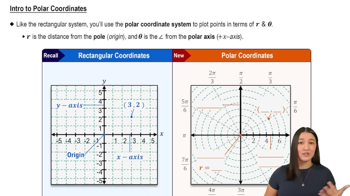
Polar coordinates represent points in the plane using a radius r and an angle θ from the positive x-axis. The relationship between Cartesian coordinates (x, y) and polar coordinates is given by x = r cos θ and y = r sin θ, allowing conversion between the two systems.
A circle's equation in Cartesian coordinates is typically expressed as (x - h)² + (y - k)² = r², where (h, k) is the center and r is the radius. Understanding this form helps identify the circle's center and radius before converting to polar form.
To convert Cartesian equations to polar form, substitute x = r cos θ and y = r sin θ into the equation. Then, simplify the resulting expression to isolate r as a function of θ, which often involves algebraic manipulation and applying trigonometric identities.

 3:38 minutes
 Verified step by step guidance
 05:32
05:32