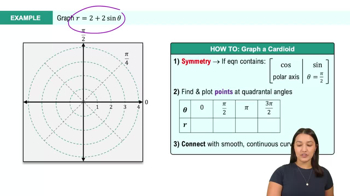
Test for symmetry with respect to a. the polar axis. b. the line θ = π/2. c. the pole. r = 4 + 3 cos θ
Verified step by step guidance
1
Recall the tests for symmetry in polar coordinates:
- Symmetry about the polar axis (the horizontal axis) means that if \((r, \theta)\) is on the graph, then \((r, -\theta)\) is also on the graph.
- Symmetry about the line \(\theta = \frac{\pi}{2}\) means that if \((r, \theta)\) is on the graph, then \((r, \pi - \theta)\) is also on the graph.
- Symmetry about the pole (origin) means that if \((r, \theta)\) is on the graph, then \((-r, \theta)\) or equivalently \((r, \theta + \pi)\) is also on the graph.
To test symmetry about the polar axis, replace \(\theta\) with \(-\theta\) in the equation and check if the equation remains unchanged. For the given equation:
\(r = 4 + 3 \cos \theta\)
Replace \(\theta\) with \(-\theta\):
\(r = 4 + 3 \cos(-\theta)\)
Use the even property of cosine, which states \(\cos(-\theta) = \cos \theta\), so the equation becomes:
\(r = 4 + 3 \cos \theta\)
Since this is the same as the original equation, the graph is symmetric about the polar axis.
To test symmetry about the line \(\theta = \frac{\pi}{2}\), replace \(\theta\) with \(\pi - \theta\) in the equation and check if the equation remains unchanged:
\(r = 4 + 3 \cos(\pi - \theta)\)
Use the identity \(\cos(\pi - \theta) = -\cos \theta\), so the equation becomes:
\(r = 4 - 3 \cos \theta\)
Since this is not the same as the original equation, the graph is not symmetric about the line \(\theta = \frac{\pi}{2}\).
Verified video answer for a similar problem:
This video solution was recommended by our tutors as helpful for the problem above
Video duration:
5m
Play a video:
0 Comments
Key Concepts
Here are the essential concepts you must grasp in order to answer the question correctly.
Symmetry with Respect to the Polar Axis
Symmetry about the polar axis means the graph remains unchanged when θ is replaced by -θ. To test this, substitute -θ into the polar equation and check if the resulting equation is equivalent to the original. This reflects symmetry across the horizontal axis in polar coordinates.
Symmetry about the line θ = π/2 occurs if replacing θ by π - θ yields an equivalent equation. This tests whether the graph is mirrored across the vertical line θ = π/2 in the polar plane. It helps identify vertical symmetry in polar graphs.
Symmetry about the pole (origin) means the graph is unchanged when (r, θ) is replaced by (-r, θ) or equivalently (r, θ + π). Testing this involves checking if r(θ) = -r(θ + π) or if the equation remains valid under these transformations, indicating origin symmetry.