Perform the indicated operations and write the result in standard form. √−32 − √−18
Verified step by step guidance
1
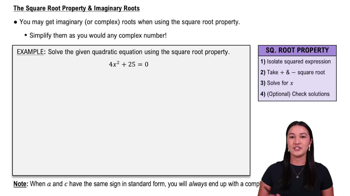
Recognize that the square roots of negative numbers involve imaginary numbers. Recall that \(\sqrt{-a} = \sqrt{a} \times i\), where \(i = \sqrt{-1}\).
Rewrite each term using the imaginary unit \(i\): \(\sqrt{-32} = \sqrt{32} \times i\) and \(\sqrt{-18} = \sqrt{18} \times i\).
Simplify the square roots of the positive numbers under the radicals by factoring out perfect squares: \(\sqrt{32} = \sqrt{16 \times 2} = 4\sqrt{2}\) and \(\sqrt{18} = \sqrt{9 \times 2} = 3\sqrt{2}\).
Substitute the simplified forms back into the expression: \(4\sqrt{2}i - 3\sqrt{2}i\).
Combine like terms by factoring out \(\sqrt{2}i\): \((4 - 3)\sqrt{2}i\), which simplifies to \(1 \times \sqrt{2}i\), or simply \(\sqrt{2}i\).
Verified video answer for a similar problem:
This video solution was recommended by our tutors as helpful for the problem above
Video duration:
2m
Play a video:
0 Comments
Key Concepts
Here are the essential concepts you must grasp in order to answer the question correctly.
Imaginary Numbers and Complex Numbers
Imaginary numbers arise from the square roots of negative numbers, defined using the imaginary unit i, where i² = -1. Complex numbers combine real and imaginary parts in the form a + bi. Understanding this allows you to rewrite √-32 and √-18 in terms of i.
Simplifying square roots involves factoring the radicand into perfect squares and other factors. For example, √32 can be simplified to 4√2 because 16 is a perfect square. This process helps in expressing the terms in a simpler form before performing operations.
Adding or subtracting complex numbers requires combining like terms: real parts with real parts and imaginary parts with imaginary parts. After simplifying the square roots, you perform the indicated subtraction by handling the imaginary components accordingly to write the result in standard form a + bi.

 2:43 minutes
 Verified step by step guidance
 3:31
3:31