Find a calculator approximation to four decimal places for each circular function value. sec 7.3159
Verified step by step guidance
1
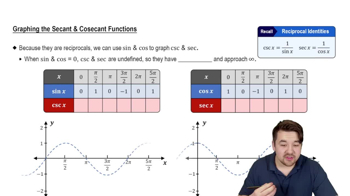
Understand that the secant function, \( \sec(\theta) \), is the reciprocal of the cosine function, \( \cos(\theta) \). Therefore, \( \sec(\theta) = \frac{1}{\cos(\theta)} \).
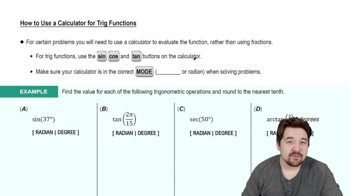
Use a calculator to find \( \cos(7.3159) \). Make sure your calculator is set to the correct mode (radians or degrees) based on the context of the problem. Since 7.3159 is a large number, it is likely in radians.
Calculate the reciprocal of the cosine value obtained: \( \sec(7.3159) = \frac{1}{\cos(7.3159)} \).
Use the calculator to find the reciprocal value, ensuring the result is accurate to four decimal places.
Verify the result by checking the calculator settings and recalculating if necessary to ensure the accuracy of the approximation.
Verified video answer for a similar problem:
This video solution was recommended by our tutors as helpful for the problem above
Play a video:
0 Comments
Key Concepts
Here are the essential concepts you must grasp in order to answer the question correctly.
Circular Functions
Circular functions, also known as trigonometric functions, relate the angles of a circle to the ratios of its sides. The primary circular functions include sine, cosine, tangent, and their reciprocals: cosecant, secant, and cotangent. Understanding these functions is essential for evaluating angles and their corresponding values in various contexts, including calculus and physics.
The secant function, denoted as sec(θ), is the reciprocal of the cosine function. It is defined as sec(θ) = 1/cos(θ). This function is particularly useful in trigonometry for solving problems involving right triangles and circular motion, and it can be calculated using a calculator for any angle expressed in radians or degrees.
Calculator approximations involve using a scientific or graphing calculator to compute the values of trigonometric functions to a specified degree of accuracy, such as four decimal places. This process typically requires inputting the angle in the correct mode (radians or degrees) and understanding how to read and interpret the output. Mastery of this skill is crucial for accurately solving trigonometric problems in both academic and practical applications.

 Verified step by step guidance
 5:57
5:57