Without using a calculator, determine which of the two values is greater. tan 1 or tan 2
Verified step by step guidance
1
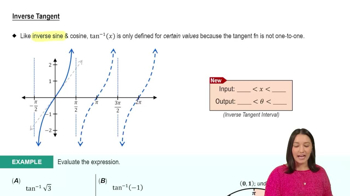
Recall that the tangent function, \(\tan x\), is an increasing function on the interval \(\left(-\frac{\pi}{2}, \frac{\pi}{2}\right)\), which means that if \(a < b\) and both are in this interval, then \(\tan a < \tan b\).
Identify the values given: \(1\) and \(2\) are in radians, and both lie within the interval \(\left(-\frac{\pi}{2}, \frac{\pi}{2}\right)\) since \(\frac{\pi}{2} \approx 1.5708\) and \(2\) is slightly greater than \(\frac{\pi}{2}\), so we need to check the domain carefully.
Note that \(1\) radian is less than \(\frac{\pi}{2}\), but \(2\) radians is greater than \(\frac{\pi}{2}\), so \(\tan 2\) is not in the principal increasing interval and the tangent function has a vertical asymptote at \(x = \frac{\pi}{2}\).
Since \(\tan x\) approaches \(+\infty\) as \(x\) approaches \(\frac{\pi}{2}\) from the left and \(-\infty\) as \(x\) approaches \(\frac{\pi}{2}\) from the right, \(\tan 2\) (where \(2 > \frac{\pi}{2}\)) will be negative because it lies in the second interval where tangent is negative.
Therefore, compare the signs and values: \(\tan 1\) is positive (since \(1 < \frac{\pi}{2}\)) and \(\tan 2\) is negative (since \(2 > \frac{\pi}{2}\)), so \(\tan 1\) is greater than \(\tan 2\).
Verified video answer for a similar problem:
This video solution was recommended by our tutors as helpful for the problem above
Play a video:
0 Comments
Key Concepts
Here are the essential concepts you must grasp in order to answer the question correctly.
Understanding the Tangent Function
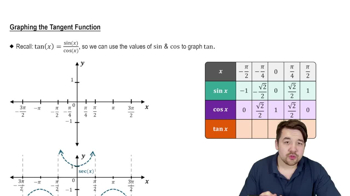
The tangent function, tan(θ), is defined as the ratio of the sine and cosine of an angle θ (tan θ = sin θ / cos θ). It is periodic and increases on intervals where cosine is positive, with vertical asymptotes where cosine equals zero. Knowing its behavior helps compare values without a calculator.
On the interval (0, π/2), the tangent function is strictly increasing, meaning that if 0 < a < b < π/2, then tan(a) < tan(b). Since 1 and 2 are in radians and both lie within this interval, this property allows direct comparison of tan 1 and tan 2.
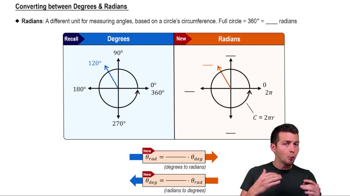
Angles measured in radians relate directly to the unit circle. Recognizing that 1 and 2 radians are between 0 and π/2 (~1.57) and π (~3.14) helps determine the behavior of trigonometric functions at these points. This context is essential for applying properties like monotonicity correctly.