Find the approximate value of s, to four decimal places, in the interval [0, π/2] that makes each statement true. sin s = 0.4924
Verified step by step guidance
1
Start by understanding that you need to find the angle \( s \) such that \( \sin s = 0.4924 \).
Since \( s \) is in the interval \([0, \pi/2]\), you are looking for an angle in the first quadrant where the sine function is positive.
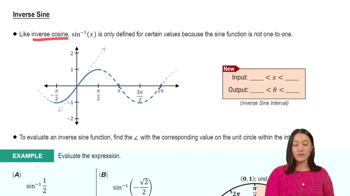
Use the inverse sine function, also known as arcsine, to find \( s \). This is written as \( s = \sin^{-1}(0.4924) \).
Use a calculator to find the approximate value of \( s \) in radians, ensuring your calculator is set to the correct mode (radians).
Round the result to four decimal places to get the final approximate value of \( s \).
Verified video answer for a similar problem:
This video solution was recommended by our tutors as helpful for the problem above
Play a video:
0 Comments
Key Concepts
Here are the essential concepts you must grasp in order to answer the question correctly.
Sine Function
The sine function, denoted as sin, is a fundamental trigonometric function that relates the angle of a right triangle to the ratio of the length of the opposite side to the hypotenuse. It is periodic and oscillates between -1 and 1. In the context of the unit circle, sin(s) represents the y-coordinate of a point on the circle corresponding to the angle s.
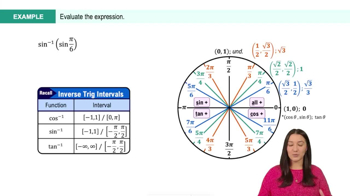
The inverse sine function, or arcsin, is used to determine the angle whose sine is a given value. It is denoted as sin⁻¹ or arcsin and is defined for values in the range [-1, 1]. The output of arcsin is restricted to the interval [-π/2, π/2], but when considering the sine function's periodicity, we can find multiple angles that yield the same sine value.
The interval [0, π/2] represents the first quadrant of the unit circle, where both sine and cosine functions are positive. In this interval, the sine function is increasing, meaning that as the angle s increases from 0 to π/2, the value of sin(s) also increases from 0 to 1. This property is crucial for finding the angle s that satisfies the equation sin(s) = 0.4924 within the specified range.

 Verified step by step guidance
 5:53
5:53