In Exercises 14–19, use a sum or difference formula to find the exact value of each expression. sin 195°
Verified step by step guidance
1
Recognize that 195° can be expressed as a sum or difference of angles whose sine and cosine values are known. For example, 195° = 180° + 15° or 195° = 210° - 15°.
Choose the difference formula for sine since 195° = 210° - 15°, and both 210° and 15° are angles with known sine and cosine values.
Recall the sine difference formula: \(\sin(A - B) = \sin A \cos B - \cos A \sin B\).
Substitute \(A = 210^\circ\) and \(B = 15^\circ\) into the formula: \(\sin 195^\circ = \sin 210^\circ \cos 15^\circ - \cos 210^\circ \sin 15^\circ\).
Use known exact values for \(\sin 210^\circ\), \(\cos 210^\circ\), \(\sin 15^\circ\), and \(\cos 15^\circ\) to express the exact value of \(\sin 195^\circ\).
Verified video answer for a similar problem:
This video solution was recommended by our tutors as helpful for the problem above
Video duration:
9m
Play a video:
0 Comments
Key Concepts
Here are the essential concepts you must grasp in order to answer the question correctly.
Sum and Difference Formulas for Sine
These formulas express the sine of a sum or difference of two angles in terms of the sines and cosines of the individual angles. Specifically, sin(a ± b) = sin a cos b ± cos a sin b. This allows the evaluation of sine for angles not commonly found on the unit circle by breaking them into sums or differences of known angles.
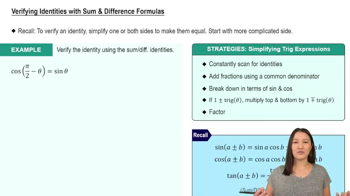
Verifying Identities with Sum and Difference Formulas
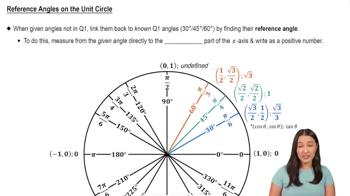
Reference Angles and Angle Decomposition
To apply sum or difference formulas effectively, the given angle (195°) is decomposed into the sum or difference of angles with known sine and cosine values, such as 180° + 15° or 210° - 15°. Understanding how to choose these angles simplifies the calculation and helps find exact trigonometric values.
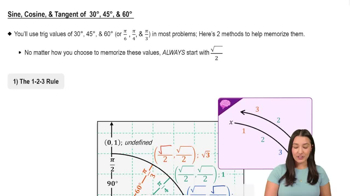
Exact Values of Sine and Cosine for Special Angles
Knowing the exact sine and cosine values for special angles like 0°, 30°, 45°, 60°, 90°, and their multiples is essential. These values serve as the building blocks when using sum or difference formulas, enabling precise computation without relying on decimal approximations.

 9:01 minutes
 Verified step by step guidance
 2:25
2:25