Use one or more of the six sum and difference identities to solve Exercises 13–54. In Exercises 13–24, find the exact value of each expression. sin(60° - 45°)
Verified step by step guidance
1
Identify the sum or difference identity that applies to the expression. Since the expression is \( \sin(60^\circ - 45^\circ) \), use the sine difference identity: \( \sin(A - B) = \sin A \cos B - \cos A \sin B \).
Substitute \( A = 60^\circ \) and \( B = 45^\circ \) into the identity: \( \sin(60^\circ - 45^\circ) = \sin 60^\circ \cos 45^\circ - \cos 60^\circ \sin 45^\circ \).
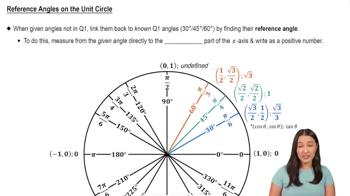
Recall the exact values of the sine and cosine for the special angles: \( \sin 60^\circ = \frac{\sqrt{3}}{2} \), \( \cos 60^\circ = \frac{1}{2} \), \( \sin 45^\circ = \frac{\sqrt{2}}{2} \), and \( \cos 45^\circ = \frac{\sqrt{2}}{2} \).
Replace the trigonometric functions in the expression with their exact values: \( \left( \frac{\sqrt{3}}{2} \right) \left( \frac{\sqrt{2}}{2} \right) - \left( \frac{1}{2} \right) \left( \frac{\sqrt{2}}{2} \right) \).
Simplify the expression by multiplying the fractions and combining like terms to find the exact value.
Verified video answer for a similar problem:
This video solution was recommended by our tutors as helpful for the problem above
Video duration:
8m
Play a video:
0 Comments
Key Concepts
Here are the essential concepts you must grasp in order to answer the question correctly.
Sum and Difference Identities
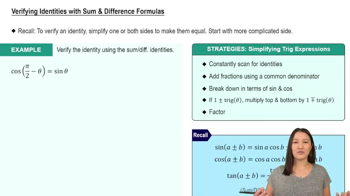
Sum and difference identities express the sine, cosine, or tangent of a sum or difference of two angles in terms of the sines and cosines of the individual angles. For sine, the identity is sin(a - b) = sin(a)cos(b) - cos(a)sin(b), which allows exact evaluation of expressions like sin(60° - 45°).
Verifying Identities with Sum and Difference Formulas
Exact Values of Common Angles
Certain angles such as 30°, 45°, 60°, and their multiples have known exact sine and cosine values involving square roots. For example, sin(45°) = √2/2 and cos(60°) = 1/2. These values are essential for calculating exact trigonometric expressions without a calculator.
Understanding that the angles given are in degrees is crucial for applying the correct trigonometric values and identities. Degrees are a common unit for measuring angles, and knowing how to work with degree measures ensures proper use of trigonometric formulas and exact values.

 8:06 minutes
 Verified step by step guidance
 2:25
2:25