In Exercises 7–14, use the given information to find the exact value of each of the following:a. sin 2θ15sin θ = -------- , θ lies in quadrant II.17
Verified step by step guidance
1
Recognize that \( \sin \theta = \frac{15}{17} \) and \( \theta \) is in Quadrant II, where sine is positive and cosine is negative.
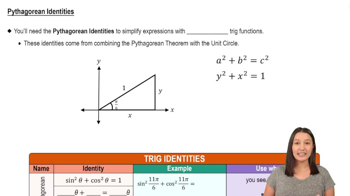
Use the Pythagorean identity \( \sin^2 \theta + \cos^2 \theta = 1 \) to find \( \cos \theta \).
Substitute \( \sin \theta = \frac{15}{17} \) into the identity: \( \left(\frac{15}{17}\right)^2 + \cos^2 \theta = 1 \).
Solve for \( \cos^2 \theta \) and then find \( \cos \theta \). Remember, since \( \theta \) is in Quadrant II, \( \cos \theta \) will be negative.
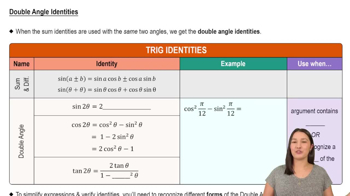
Use the double angle formula for sine: \( \sin 2\theta = 2 \sin \theta \cos \theta \) to find \( \sin 2\theta \).
Verified video answer for a similar problem:
This video solution was recommended by our tutors as helpful for the problem above
Video duration:
4m
Play a video:
0 Comments
Key Concepts
Here are the essential concepts you must grasp in order to answer the question correctly.
Sine Function and Its Values
The sine function, denoted as sin(θ), represents the ratio of the length of the opposite side to the hypotenuse in a right triangle. In this problem, sin(θ) is given as 15/17, which indicates that for angle θ in quadrant II, the sine value is positive while the cosine value is negative. Understanding the sine function's behavior in different quadrants is crucial for solving trigonometric problems.
The double angle formula for sine states that sin(2θ) = 2sin(θ)cos(θ). This formula allows us to find the sine of double an angle using the sine and cosine of the original angle. To apply this formula, we need to calculate cos(θ) using the Pythagorean identity, which relates sine and cosine values.
The Pythagorean identity states that sin²(θ) + cos²(θ) = 1. This identity is essential for finding the cosine value when the sine value is known. In this case, since sin(θ) = 15/17, we can use this identity to calculate cos(θ) and subsequently find sin(2θ) using the double angle formula.

 4:16 minutes
 Verified step by step guidance
 5:08
5:08