Match each expression in Column I with its value in Column II. (2 tan (π/3))/(1 - tan² (π/3))
Verified step by step guidance
1
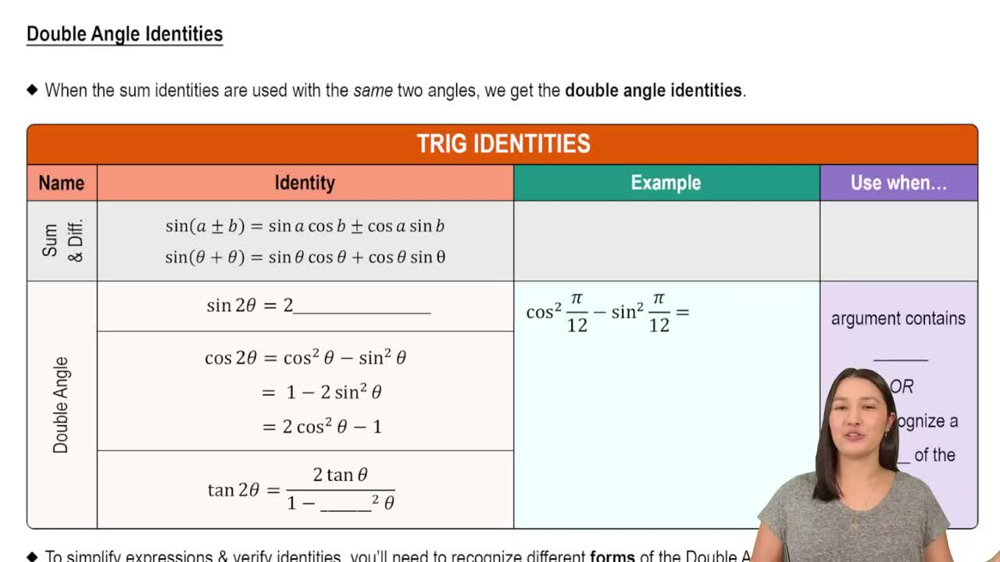
Recognize that the given expression \( \frac{2 \tan\left(\frac{\pi}{3}\right)}{1 - \tan^2\left(\frac{\pi}{3}\right)} \) matches the double-angle formula for tangent, which is \( \tan(2\theta) = \frac{2 \tan \theta}{1 - \tan^2 \theta} \).
Identify \( \theta = \frac{\pi}{3} \) in the expression, so the expression simplifies to \( \tan\left(2 \times \frac{\pi}{3}\right) = \tan\left(\frac{2\pi}{3}\right) \).
Recall or calculate the value of \( \tan\left(\frac{2\pi}{3}\right) \) by considering the unit circle or reference angles.
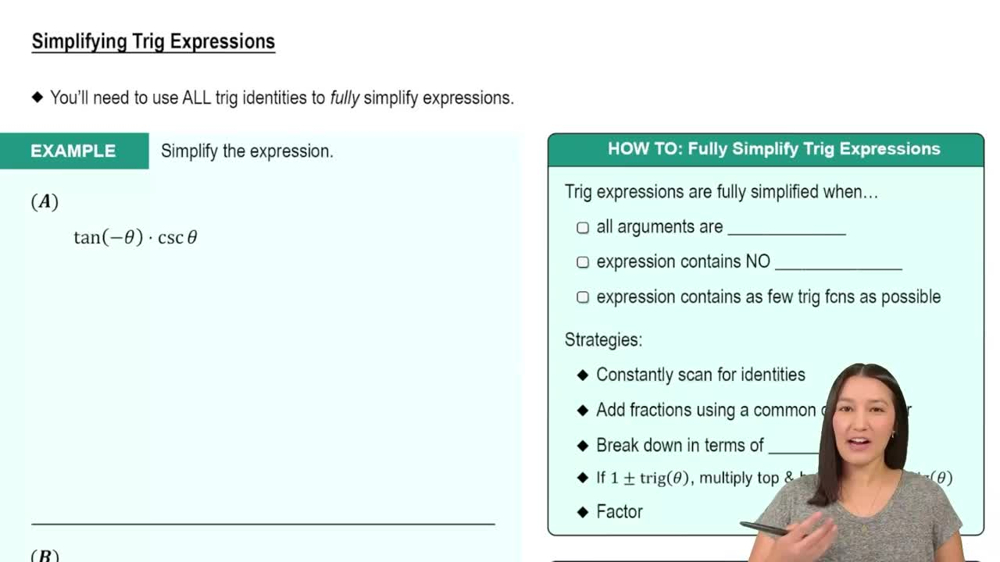
Use the fact that \( \frac{2\pi}{3} = \pi - \frac{\pi}{3} \), and since tangent is negative in the second quadrant, \( \tan\left(\frac{2\pi}{3}\right) = -\tan\left(\frac{\pi}{3}\right) \).
Finally, substitute the known value of \( \tan\left(\frac{\pi}{3}\right) = \sqrt{3} \) to find the value of the expression.
Verified video answer for a similar problem:
This video solution was recommended by our tutors as helpful for the problem above
Play a video:
0 Comments
Key Concepts
Here are the essential concepts you must grasp in order to answer the question correctly.
Tangent Function and Its Values
The tangent function, tan(θ), is defined as the ratio of the sine and cosine of an angle θ. Knowing exact values of tangent at special angles like π/3 (60°) is essential; for example, tan(π/3) = √3. This helps in evaluating expressions involving tangent directly.
The double-angle formula for tangent states that tan(2θ) = (2 tan θ) / (1 - tan² θ). This formula allows simplification of expressions involving tangent of multiple angles by relating them to the tangent of a single angle, which is crucial for matching or evaluating given expressions.
Simplifying trigonometric expressions involves substituting known values and applying identities to reduce the expression to a simpler or recognizable form. This skill is necessary to match expressions with their equivalent values, especially when dealing with compound angles or rational expressions.

 Verified step by step guidance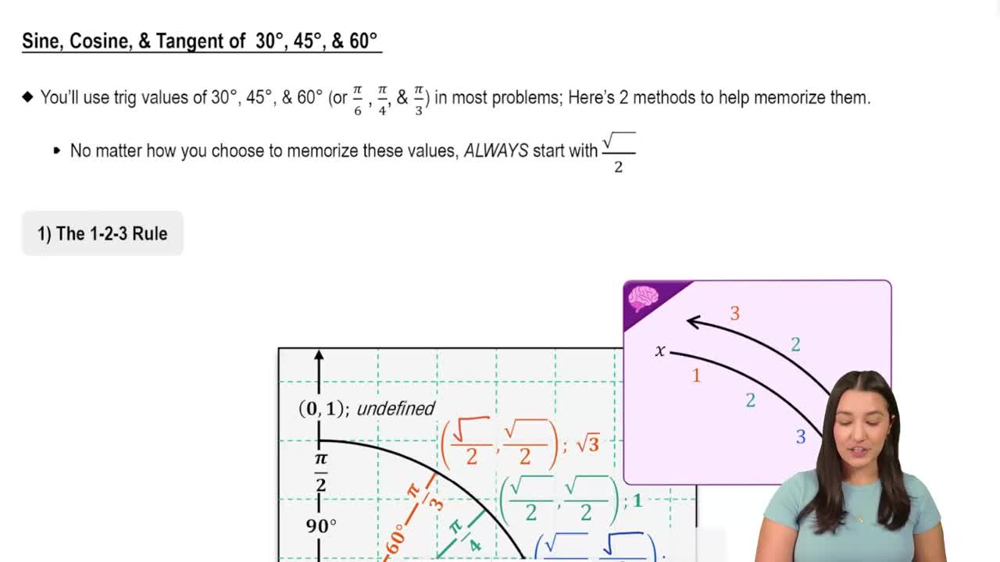
 5:08
5:08