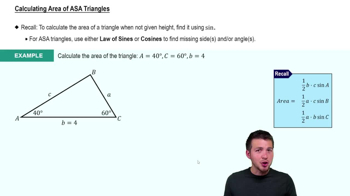
Find the area of each triangle using the formula 𝓐 = ½ bh, and then verify that the formula 𝓐 = ½ ab sin C gives the same result. <IMAGE>
Verified step by step guidance
1
Identify the base (b) and the height (h) of the triangle from the given image or information. The base is one side of the triangle, and the height is the perpendicular distance from the opposite vertex to this base.
Use the formula for the area of a triangle based on base and height: \(\mathcal{A} = \frac{1}{2} b h\). Substitute the values of base and height into this formula to express the area.
Next, identify two sides of the triangle, say \(a\) and \(b\), and the included angle \(C\) between them from the image or given data.
Use the formula for the area of a triangle using two sides and the included angle: \(\mathcal{A} = \frac{1}{2} a b \sin C\). Substitute the values of sides \(a\), \(b\), and angle \(C\) into this formula.
Compare the two expressions for the area obtained from the two formulas to verify that they give the same result, confirming the consistency of the area calculation methods.
Verified video answer for a similar problem:
This video solution was recommended by our tutors as helpful for the problem above
Play a video:
0 Comments
Key Concepts
Here are the essential concepts you must grasp in order to answer the question correctly.
Area of a Triangle Using Base and Height
The formula 𝓐 = ½ bh calculates the area of a triangle by multiplying the base length (b) by the height (h) perpendicular to that base, then dividing by two. This method requires knowing the height, which is the perpendicular distance from the base to the opposite vertex.
Area of a Triangle Using Two Sides and Included Angle
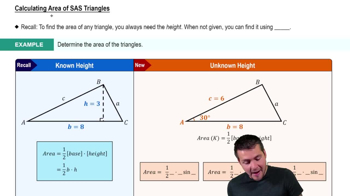
The formula 𝓐 = ½ ab sin C finds the area by using two sides (a and b) and the sine of the included angle (C) between them. This approach is useful when the height is not known but two sides and the included angle are given, leveraging trigonometric relationships.
Both formulas calculate the same area but use different known elements: one uses base and height, the other uses two sides and the included angle. Verifying equality involves understanding that height can be expressed as b sin C, linking the two methods through trigonometry.