Determine the number of triangles ABC possible with the given parts.
a = 50, b = 26, A = 95°
Verified step by step guidance
1
Identify the given elements: side \(a = 50\), side \(b = 26\), and angle \(A = 95^\circ\). Note that angle \(A\) is opposite side \(a\).
Use the Law of Sines to find angle \(B\). The Law of Sines states: \(\frac{a}{\sin A} = \frac{b}{\sin B}\). Substitute the known values to get \(\frac{50}{\sin 95^\circ} = \frac{26}{\sin B}\).
Rearrange the equation to solve for \(\sin B\): \(\sin B = \frac{26 \times \sin 95^\circ}{50}\).
Evaluate \(\sin B\) and determine the possible values of angle \(B\). Since \(\sin B\) can correspond to two different angles between \(0^\circ\) and \(180^\circ\) (one acute and one obtuse), consider both possibilities for \(B\).
For each possible value of \(B\), calculate angle \(C\) using the triangle angle sum property: \(C = 180^\circ - A - B\). Check if \(C\) is positive and valid. The number of valid triangles corresponds to the number of valid \(C\) values found.
Verified video answer for a similar problem:
This video solution was recommended by our tutors as helpful for the problem above
Play a video:
0 Comments
Key Concepts
Here are the essential concepts you must grasp in order to answer the question correctly.
Law of Sines
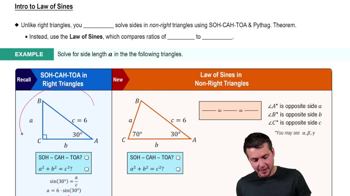
The Law of Sines relates the sides and angles of a triangle through the ratio a/sin A = b/sin B = c/sin C. It is essential for solving triangles when given two sides and an angle, especially to find unknown angles or sides.
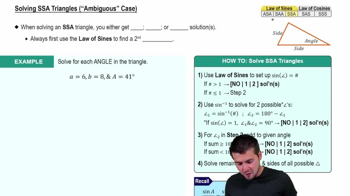
When two sides and a non-included angle (SSA) are given, there can be zero, one, or two possible triangles. This ambiguity arises because the given angle and side lengths may correspond to different triangle configurations.
The triangle inequality states that the sum of any two sides must be greater than the third. Also, larger angles face longer sides. These principles help determine if a triangle is possible and how many distinct triangles can be formed.